Does Real Pumice Float? Why the Float Test Can Mislead You
浮石会浮吗
A floating pumice stone can be a useful clue about porosity and density, but it does not prove a stone is natural. Here is what the float test really means.
Drop a pumice stone into a glass of water and it floats. Does that prove it is real volcanic pumice?
Not by itself.
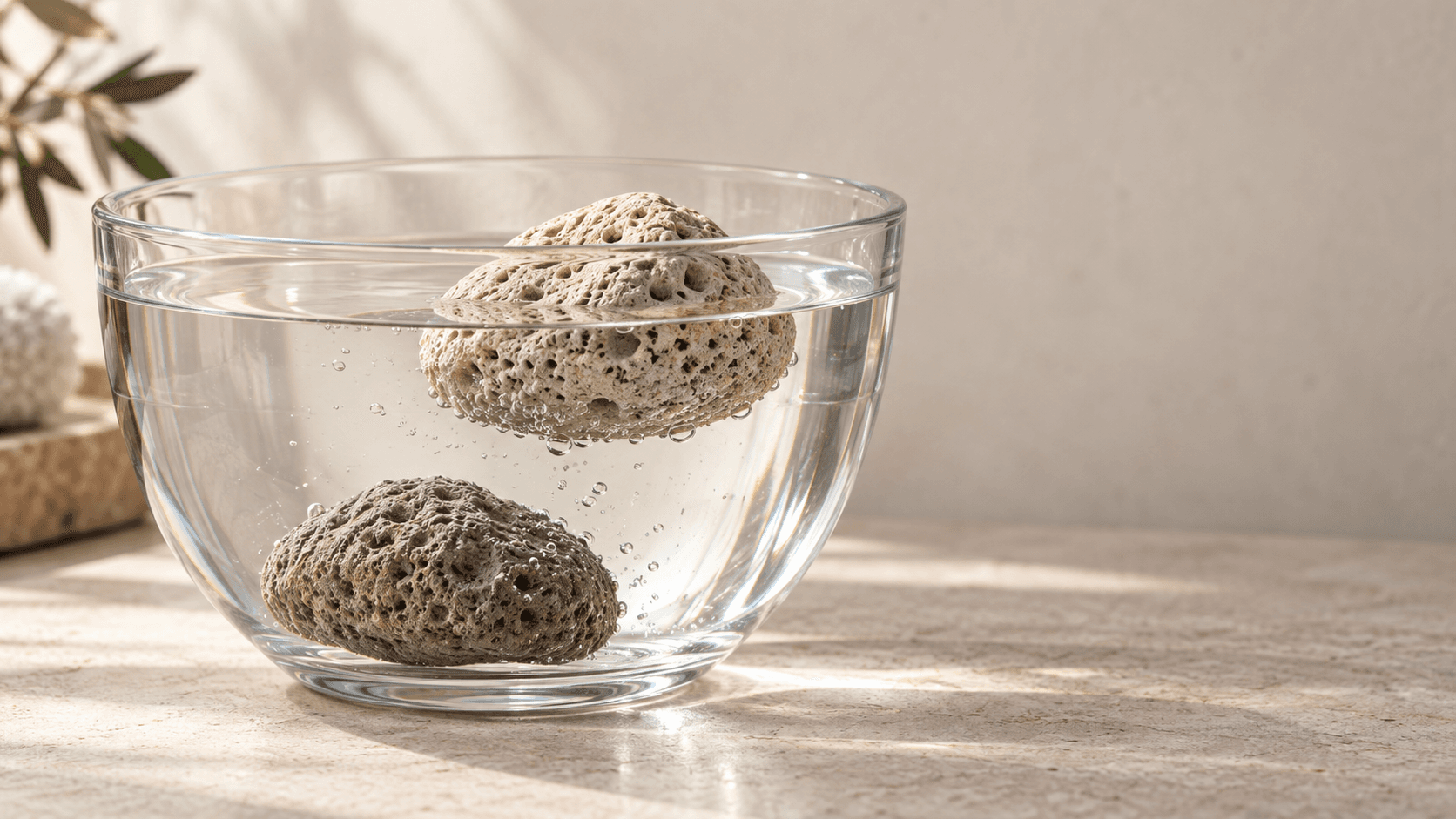
The float test is a satisfying piece of kitchen science, but it is a clue—not an authenticity certificate. Natural volcanic pumice can float because it is full of gas-bubble spaces called vesicles. Yet a natural piece can also take on water and sink. And a manufactured, foam-like abrasive material can float too.
If you are trying to understand a natural pumice stone for feet, the more useful question is not “Did it float?” It is “What does this result tell me alongside the stone’s structure, density, and material disclosure?”
The short answer
Real pumice can float when its overall density is lower than water. That depends on how much solid volcanic material it contains, how much air remains in its pores, and how quickly water can enter those pores. The U.S. Geological Survey notes that pumice may be light enough to float when vesicles are closed against rapid water filling; it also notes that an extremely vesicular volcanic material can sink when its vesicles are open and interconnected.1
So these two internet rules are both too simple:
- “Real pumice always floats.”
- “If it sinks, it must be fake.”
Neither is a reliable conclusion.
Why pumice can float at all
Pumice is a volcanic rock created when gas-rich molten rock rapidly decompresses and cools. Expanding gas leaves bubble-like cavities—vesicles—in volcanic glass, making the piece much less dense than solid rock of the same size.
Whether an object floats is about its average, or bulk, density. A stone with enough air-filled space can have an average density below water and float even though the volcanic glass forming its walls is much denser than water.
Like foam, enclosed empty space can lower an object’s average density.
Pores are not all connected in the same way
The important detail is not merely “how many holes can I see?” Pumice has a three-dimensional pore network. Some vesicles may be largely enclosed. Some connect to the outside through narrow paths. Others may connect more openly.
That architecture affects what happens in water:
- More retained gas and slower water entry can help a piece remain buoyant.
- Open, interconnected pores may let water displace gas and increase the piece’s mass.
- Pore size, pore throats, cracks, and the stone’s shape can all change the rate.
This is why a floating result can be temporary. Research on pumice saturation describes an initial period in which larger accessible pores can take in water, followed by slower absorption over much longer periods.2 More recent work also shows that connected and dead-end pores can influence how water moves through pumice, and therefore how long it remains afloat.3
Natural pumice may float for minutes, days, months—or longer
There is no single “correct” float time. Natural pumice fragments have been documented floating for very long periods, including years in some settings,4 but a small foot-care stone should not be expected to repeat that behavior in a glass.
Size, porosity, permeability, prior wetting, surface coatings, damage, water temperature, and water salinity all matter. A natural volcanic pumice stone may float briefly, float for a long time, bob partly submerged, or eventually sink. Duration is physical behavior, not a brand or origin label.
Why a genuine stone can sink
A genuine volcanic pumice stone can sink if its bulk density is at or above that of the water, or if enough water enters its pore system to raise its effective density over time. Open and interconnected vesicles are especially relevant. The USGS gives a helpful counterexample: reticulite, an exceptionally vesicular volcanic material, does not float because its vesicles are open and interconnected.1
This means sinking is not proof that a stone is synthetic. It may instead reflect its pore connectivity, a denser portion of a natural deposit, prior water absorption, or a piece that has been shaped from a different part of the material.
Why a floating stone is not automatically natural
Floating tells you that the object is buoyant in that particular water, at that particular time. It does not identify what the object is made of.
Manufactured porous materials—including pumice-style abrasive blocks—can contain air-filled cells and may float. Coatings, cracks, and trapped surface air can also affect a quick test. Do not use this test to accuse a seller of mislabeling: it cannot establish a product’s material history.
What the Float Test Can Tell You — and What It Can’t
| What you observe | What it can suggest | What it cannot prove |
|---|---|---|
| It floats when first placed in water | Its bulk density is lower than that water at that moment | That it is natural volcanic pumice |
| It slowly takes on water or sinks later | Water is entering enough accessible pore space to affect buoyancy | That it was ever “fake” or that it is not volcanic |
| It sinks right away | Its effective density in that test is not low enough for buoyancy | That it is synthetic or unsuitable for its intended use |
| It stays afloat for a long time | It is retaining enough gas-filled space to remain buoyant | Its source, geology, or manufacturing method |
The distinction matters because buoyancy is a measurement of behavior, not an origin document.
A simple home experiment: observe, don’t certify
If you are curious, run the test as a comparison exercise—not as a verdict.
What you need
- A clear bowl or tall glass
- Room-temperature tap water
- A dry pumice stone
- A timer or phone
- A notebook or notes app
Method
- Start with a dry stone. Photograph it and note its approximate size, color, visible pores, and whether it feels unusually light for its size.
- Fill the container with enough water that the stone will not touch the bottom if it floats.
- Gently place the stone on the water. Do not press it below the surface; that can force water into accessible pores and changes the experiment.
- Record whether it floats, bobs, partly submerges, or sinks. Note the time.
- Check it again after 5 minutes, 30 minutes, and 24 hours if you want to continue. Keep the conditions the same.
- Remove it, blot its surface, and compare its feel and weight only qualitatively. Do not treat a home scale reading as a precise absorption measurement.
What to record
- Did it begin floating immediately?
- How much of it sat above the waterline?
- Did bubbles leave the stone?
- Did its position change with time?
- Did it appear darker or feel wetter afterward?
These observations can reveal how this one specimen interacts with water. They cannot confirm that the stone is natural, identify its volcanic source, or establish a universal rule for all pumice.
Common mistakes that make the test less useful
Forcing the stone underwater. This may drive water into open pores and changes the passive-float result.
Comparing unlike stones. Size, shape, pore structure, and previous moisture all matter.
Stopping too soon. Seconds in water do not predict behavior after an hour or a day.
Treating a viral clip as a standard. It rarely reveals whether the sample was dry, soaked, coated, or pressed underwater.
Using flotation as the only buying criterion. Material disclosure and visible irregular porous structure add important context.
A better way to assess a “real pumice” claim
No single at-home test proves authenticity. Instead, look for several pieces of evidence that agree:
- Clear disclosure. Does the seller specifically say natural volcanic pumice?
- Origin information. Is material origin or sourcing explained?
- Irregular cellular structure. Varied pores and walls are a clue, not proof.
- Physical behavior. Lightness, water absorption, and flotation can support the picture, with limitations.
- Transparency. Documentation is more useful than one kitchen demonstration.
A broken cross-section may reveal irregular vesicles throughout, but should be paired with material documentation—not treated as laboratory identification.
The bottom line
The float test is worth doing if it makes you more curious about the structure of pumice. It is not strong enough to settle an authenticity claim. The best evidence is a combination of material origin, transparent disclosure, visible structure, and physical characteristics—not one viral trick.
Pumice Valley uses natural volcanic pumice and believes the material should be explained, not mystified. Explore how a natural pumice stone’s origin and porous structure can make every piece a little different.
Footnotes
-
U.S. Geological Survey, Eruptions of Hawaiian Volcanoes, “Pumice and reticulite.” ↩ ↩2
-
Manville, V., White, J. D. L., Houghton, B. F., & Wilson, C. J. N. (1998). “The saturation behaviour of pumice and some sedimentological implications.” Sedimentary Geology, 119(1–2), 5–16. ↩
-
Kawasaki, K., & Takeuchi, S. (2025). “Pumice flotation time: how does the infiltration of water progress inside pumice?” Progress in Earth and Planetary Science, 12, 38. ↩
-
Jutzeler, M. et al. (2021). “Sink or float: microtextural controls on the fate of pumice deposition during the 2012 submarine Havre eruption.” Bulletin of Volcanology, 83, 47. ↩
FAQ
Does real pumice float?^
Real volcanic pumice can float when enough gas-filled pore space keeps its bulk density below water. Some genuine pieces may sink.
Does a real pumice float test prove it is natural?^
No. Floating is one physical clue, but porous manufactured materials can float too. The test does not prove origin or composition.
Why did my pumice stone sink after it floated?^
Water may have entered accessible pores and displaced enough trapped gas to raise the stone’s effective density.
Can a natural pumice stone sink immediately?^
Yes. Natural volcanic pieces vary in density and pore connectivity, so immediate sinking does not prove a stone is synthetic.
Does salt water change the pumice stone water test?^
Yes. Salt water is denser than fresh water and can change buoyancy, so comparisons should use the same water and method.
How can I tell if pumice is real?^
Look for multiple clues together: clear material disclosure, source information, irregular pore structure, and physical observations. No home test proves authenticity alone.