Can You Identify Real Pumice by Weight? Why Density Matters More Than Grams
浮石密度更重要
A scale can show grams, but it cannot prove whether a pumice stone is natural. Learn why density, size, pore structure and material disclosure tell a more useful story.
A kitchen scale can tell you how much a pumice stone weighs. It cannot, by itself, tell you whether that stone is natural volcanic pumice or a manufactured abrasive block. That is because weight is only one half of the useful question. The other half is volume: how much space the particular stone occupies.
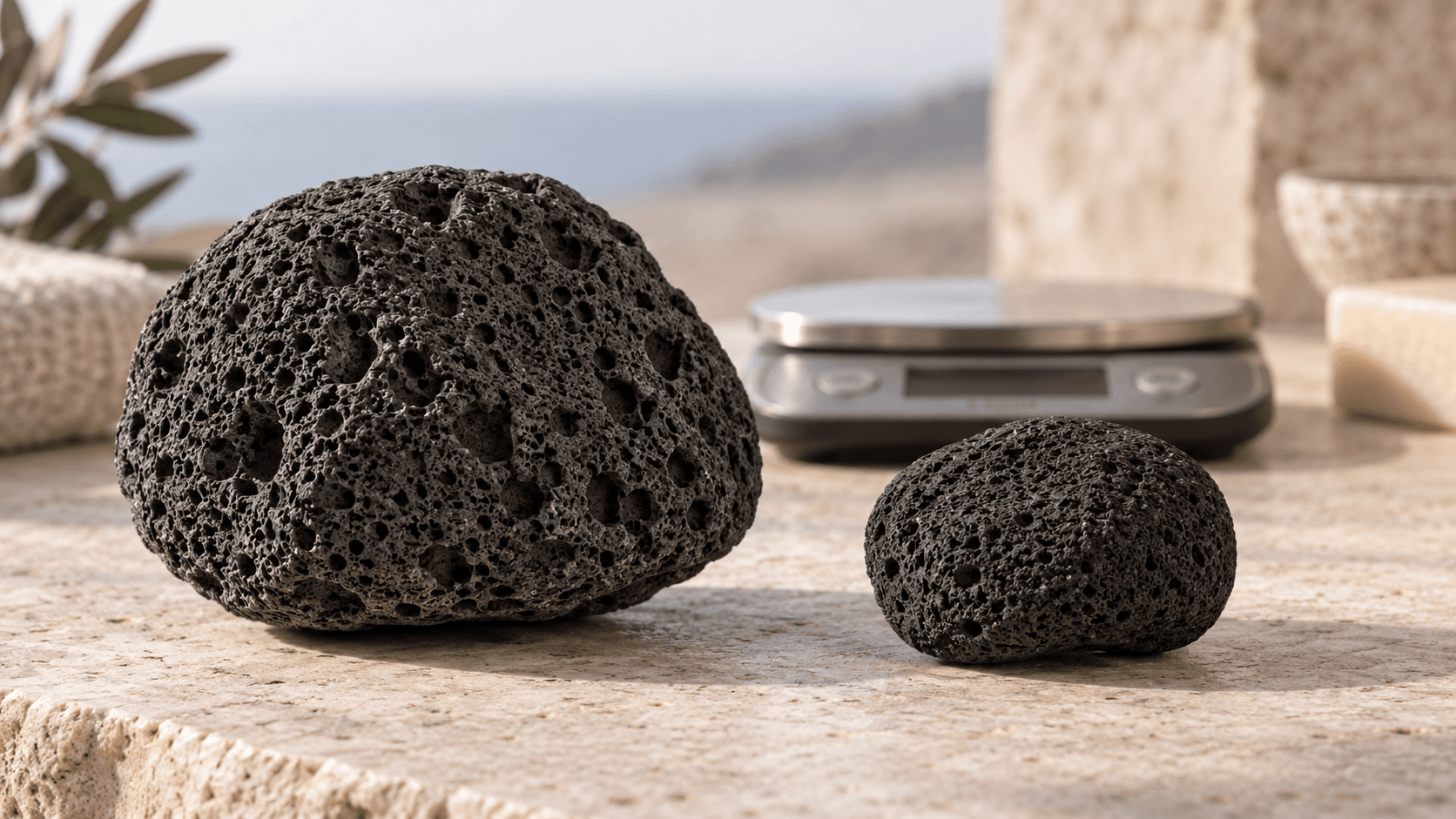
That distinction matters when shopping for a real pumice stone or comparing a synthetic pumice stone with a natural option. Volcanic pumice is full of gas-bubble cavities, called vesicles, but the amount, size, shape, and connection of those cavities vary from one piece of rock to another. A smaller natural stone can weigh less than a larger one simply because it is smaller. Two stones that look similarly sized can also weigh differently because their pore structures are different.
So use weight as a clue, not a verdict. The most transparent way to evaluate a stone is to consider its approximate density, porous structure, material disclosure, and origin together.
Weight and density are not the same thing
Weight is the mass shown by a scale: grams or ounces. Density describes how much mass is packed into a given volume. In simple terms:
density = mass ÷ volume
For everyday comparisons on Earth, a scale's grams are a practical stand-in for mass. Volume is the amount of three-dimensional space a stone takes up, commonly expressed in cubic centimeters (cm³).
Geologists describe pumice as highly vesicular volcanic glass. Vesicles are cavities created when gases expand in molten material during an eruption and the material cools quickly. The solid glassy framework is much denser than water, but the mixture of framework and air-filled pore space can give a piece of pumice a low bulk density. The U.S. Geological Survey lists a representative density range of 700–1,200 kg/m³ for pumice fragments in volcanic ash; individual specimens and measurements can vary with composition, porosity, moisture, and method. USGS density reference
That range is useful geology, not a consumer-authentication threshold. A shaped foot-care stone is not necessarily the same size, moisture condition, or material population as the fragments in a volcanic-ash study.
Why natural pumice can vary so much
Natural volcanic pumice does not form in a mold. Gas content, cooling rate, melt composition, pressure, and movement during an eruption all affect the resulting pores. One piece may have many fine cavities; another may have fewer, larger cavities or a denser-looking outer area. Later cutting, trimming, abrasion, and handling can change its shape without erasing that geological variation.
That means a natural pumice stone may be light for its size, moderately light, or surprisingly substantial in the hand. It may be pale, gray, tan, or darker depending on composition and weathering. It may also include more solid material in one part than another. None of these observations proves origin alone.
Water adds another variable. Open or connected pores can take in water. A stone weighed dry, then weighed after a soak, can register very differently. Researchers studying porous volcanic rock distinguish dry, saturated, bulk, skeletal, and solid density because pore access changes the result. A recent open-access study of pumice describes how connected and isolated pores complicate simple water-displacement measurements. Takeuchi & Suwa, 2026
Why “real pumice weighs X grams” is a bad rule
Online rules such as “real pumice weighs 40 grams” sound reassuring because they are easy to repeat. They fail for several practical reasons:
- Size changes the answer. A 40-gram pebble-sized stone and a 40-gram palm-sized stone do not have the same density.
- Shape changes apparent size. An irregular oval, a rectangle, and a rounded stone may look comparable but enclose different volumes.
- Pores are variable. Natural vesicles are not uniform from stone to stone.
- Moisture changes mass. A damp porous stone can be heavier than it was dry.
- Manufactured materials vary too. A manufactured abrasive block can be engineered to be light, porous, or consistently sized.
- Scales and photos are imperfect. A small kitchen scale, a rounded edge, and a perspective-distorted product photo are not laboratory instruments.
A fixed gram number can therefore create false confidence in both directions. It may reject a genuine piece that happens to be denser or smaller, and it may reassure a buyer about a non-volcanic material engineered to fit the expected number.
A better comparison: similar size, then compare weight
Weight becomes more useful when you compare stones that are genuinely similar in size and condition. Start with dry stones, preferably after they have been kept at room temperature in a dry place. Measure each stone's longest length, width, and thickness. For a roughly block-like stone, multiply those measurements to create a rough volume estimate. It will not be exact for rounded or irregular shapes, but it helps prevent an obvious apples-to-oranges comparison.
For example, consider two hypothetical dry stones:
| Stone | Approximate dimensions | Rough volume | Scale reading | Approximate density |
|---|---|---|---|---|
| A | 8 × 5 × 2 cm | 80 cm³ | 56 g | 0.70 g/cm³ |
| B | 8 × 5 × 2 cm | 80 cm³ | 96 g | 1.20 g/cm³ |
Stone A is lighter for approximately the same external size. That may be consistent with more pore space, but it does not establish that A is natural pumice or that B is synthetic. The stones could differ in exact shape, trapped moisture, mineral composition, manufacturing process, or unmeasured internal structure. The calculation is a comparison tool, not a certificate of authenticity.
A simple at-home density comparison
If you want a more disciplined home observation, use a scale, ruler, notebook, and several similar dry stones. Record the date and whether each sample is dry to the touch. Then:
- Measure length, width, and thickness in centimeters.
- Multiply the measurements for a rough volume if the stone is close to a block shape.
- Weigh the stone in grams.
- Divide grams by rough cubic centimeters.
- Compare only stones with similar shapes and sizes, and label the result “approximate.”
An irregular natural stone makes rectangular measurements especially rough. Water displacement can sometimes estimate volume more closely, but it has its own limitations: a very porous sample may float, shed bubbles, absorb water, or change mass while you measure it. Do not force a floating stone underwater, and do not use a method that damages a product you plan to use. For a home comparison, consistency and careful notes are more valuable than a falsely precise decimal.
What absorbed water does to a result
Pumice is often discussed as a light rock because its pores can contain gas. Whether those pores stay air-filled, connect to the surface, or gradually admit water affects both mass and buoyancy. USGS explains that a pumice piece floats when voids remain sufficiently bounded to keep water from displacing the gas; if water enters enough pore space, that favorable density contrast can be lost. USGS, “Rocks float briefly where lava meets the sea”
For this reason, never compare a freshly soaked stone with a dry one and treat the difference as a material verdict. Record whether it was dry, freshly rinsed, or soaked. If an article, video, or product listing gives only grams, it is reasonable to ask: compared with what volume, and in what moisture condition?
What weight can and cannot tell you
Weight can be a useful clue when it is part of a pattern. A stone that is unusually heavy or unusually light for similarly sized samples may prompt a closer look at its pores and product disclosure. It can also help you understand why two natural stones feel different in hand.
Weight cannot prove a source. It does not identify a quarry, eruption, or manufacturing process. It cannot distinguish all volcanic pumice from all pumice-style abrasives, and it cannot certify suitability for foot care. Treat any absolute claim based on grams alone with caution.
More useful observations include the seller's material and origin disclosure, irregular pore structure, and whether weight, water behavior, and visible structure tell a compatible story. Even that combination is evidence to weigh, not a substitute for documentation or laboratory material analysis.
Does low density make a stone better for feet?
Not automatically. Density and pore structure may influence how a stone feels, but comfort depends on many factors: the stone's surface, pressure, skin condition, technique, and whether the skin is intact. A natural pumice stone for feet should be used gently on softened, intact skin. Stop if it hurts or leaves skin tender, and avoid abrasive self-treatment on broken, inflamed, or infected-looking skin. People with diabetes, neuropathy, poor circulation, or reduced sensation should seek individualized clinical guidance before using exfoliating tools.
The point of checking material is transparency, not a promise that one number produces a particular cosmetic or health outcome.
Compare the whole picture
A scale is a useful tool, but grams are only the start of the story. Compare similar sizes, note whether a stone is dry, and look at density, porosity, visible structure, and seller documentation together. Pumice Valley encourages that fuller, more transparent approach: learn about a stone's origin and structure, not just the number on the scale.
FAQ
How much should a real pumice stone weigh?^
There is no universal gram value. Weight varies with a stone's size, shape, pore structure and moisture condition.
Is natural pumice always lighter than synthetic pumice?^
No. Both natural and manufactured materials can vary, so weight alone cannot identify origin.
Can I calculate pumice density at home?^
You can make a rough comparison by dividing a dry stone's weight by an estimated volume, but it is not proof of authenticity.
Does a heavier stone mean it is fake?^
No. It may be larger, denser, wetter or made of a different material; assess several characteristics together.
Does real pumice float?^
Some natural pumice can float, depending on density and whether water enters its pores. Float behavior alone is not conclusive.