Why Natural Pumice Stones Never Look Exactly the Same
天然浮石各不相同
Natural volcanic pumice stones vary in pores, color, shape, texture, and weight for real geological reasons. Learn what that variation means—and why it is not proof of authenticity on its own.
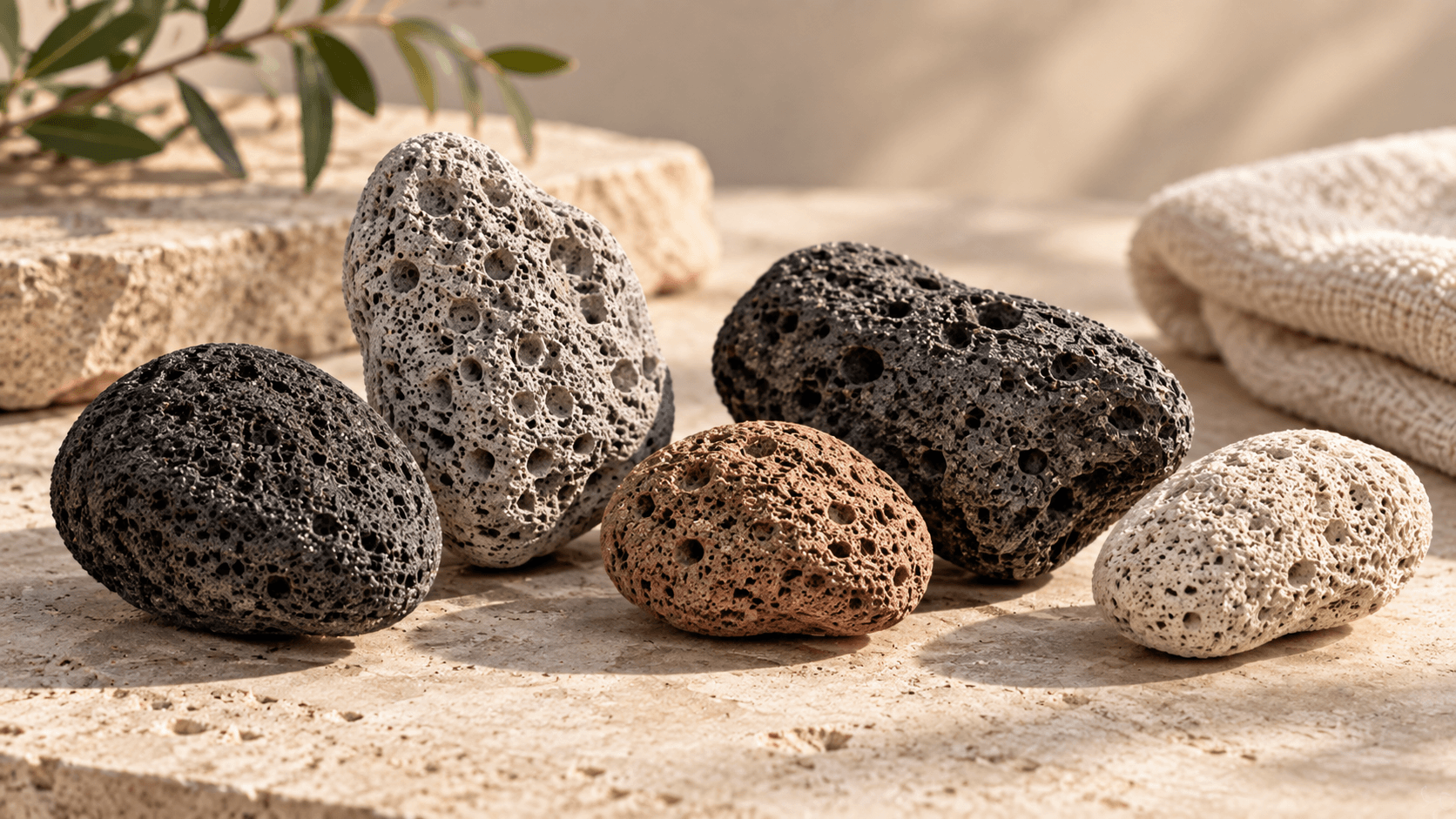
Put several natural pumice stones on a table and they may look like relatives, not twins. One may be pale and fine-pored; another darker, more open, flatter, or a little heavier. For a natural volcanic material, that variety is normal.
Natural variation is expected in volcanic pumice, but it does not prove a stone is natural. Manufactured products can look irregular, and natural pumice can be cut into a tidy shape. Pair what you see with clear material and origin information from the seller.
Here is why a natural pumice stone rarely looks exactly like the next one—and why that can be a feature of transparent material sourcing rather than a flaw.
What natural volcanic pumice is
Pumice is a porous volcanic rock made mostly of rapidly cooled volcanic glass. When gas-rich magma rises and erupts, the pressure drop allows dissolved gases to expand into bubbles. Rapid cooling preserves many of those bubble spaces, called vesicles, inside the rock.1
Vesicles are the holes and cavities that give volcanic pumice texture its porous look. They can be small or large, stretched, joined, open, or enclosed. Their volume affects feel, weight, and water behavior.1
Nature Doesn’t Use a Mold
In a manufactured item, a maker can specify dimensions, texture, color, and a tolerance for variation. In a volcanic deposit, conditions are not fixed from one fragment to the next.
Natural pumice can vary because of:
- Gas bubbles: how many bubbles formed, how large they grew, and whether neighboring bubbles merged.
- Cooling and movement: a fragment may cool, stretch, or deform differently as magma fragments and travels through an eruption.
- Minerals and glass: different amounts of crystals, glass, and tiny mineral grains can change color and density.
- Location in the deposit: material from different parts of an eruption or deposit can have different physical properties.
- Extraction and finishing: a stone may be broken naturally, then trimmed, cut, or smoothed to make it easier to hold.
A peer-reviewed study of Mount Mazama pumice found differences in vesicularity, permeability, and interconnected pore volume between clasts from different eruptive deposits.2 Studies also document multiple vesicle-size populations and bubble coalescence.3
Why color can vary
Natural pumice can be off-white, cream, gray, tan, brown, or darker depending on composition, mineral content, oxidation, weathering, and surface dust. One piece may show more than one tone.
Color is therefore a poor stand-alone test. A black stone is not automatically natural, and a pale stone is not automatically volcanic pumice. Lighting and wetness also shift how a color appears. Consider color as a descriptive detail, not a verdict about origin.
Why pore size and texture can vary
You may see dense pinprick pores on one stone, larger openings on another, and a mix on a third. Some pores connect; others are more isolated. This changes how a stone feels, but neither a more open nor a tighter-pored surface is automatically better or proof of authenticity.
The variation also affects water behavior. Low bulk density can allow pumice to float, but connected pores can fill with water and some pieces may sink. USGS notes both possibilities in its explanation of tephra.4 A single float test can show something about that individual stone’s density and pore connectivity at that moment; it cannot prove a stone is natural or synthetic.
Why shape can vary—even after a stone is made retail-ready
Pumice begins as broken volcanic material, so its original fragments are not identical. Retail stones may be selected, cut, tumbled, or shaped for a hand-friendly form. That means two things can be true at once:
- A natural real pumice stone appearance may include uneven contours, corners, and different faces.
- A natural stone can also look fairly uniform because it has been finished after extraction.
A perfect oval, clean edges, or a convenient hanging-loop shape is not proof of a synthetic material. By the same token, a rough outline is not proof of volcanic origin. Origin documentation and honest material disclosure carry more weight than silhouette.
Why density and weight can vary
Weight depends on more than whether a stone is real. Size matters, but so do pore volume, how much solid glass and mineral material the stone contains, whether pores connect, and whether the stone has absorbed water.
“Real pumice weighs X grams” is not a useful rule. USGS reports about 700–1,200 kg/m³ for individual pumice fragments in ash, with composition and moisture influencing density.5 That is geological context, not a retail threshold. Two authentic natural stones may not match each other; a manufactured porous abrasive may also be light.
Imagine 10 genuine stones side by side
Imagine a tray holding 10 natural volcanic pumice stones from a documented source. All 10 can be genuine, while still differing in visible ways:
| Stones in the tray | A normal difference you might see | What it may reflect |
|---|---|---|
| 1–2 | Fine pores and a smoother-looking face | Smaller vesicles or a less-open surface area |
| 3–4 | Larger open pores and a more textured edge | Larger or merged vesicles; later breakage along thin walls |
| 5–6 | Cream, gray, or tan tones | Composition, minerals, weathering, or surface condition |
| 7–8 | A flatter or more rounded outline | Natural fragment shape plus retail trimming or tumbling |
| 9–10 | Slightly different weight at similar size | Different porosity, mineral content, or moisture |
This illustration shows why expecting 8–10 natural stones to match exactly can lead to the wrong conclusion.
Does variation mean quality?
Not by itself. Variation is expected in natural materials, but it is not a blank check for poor finishing, excessive crumbling, unclear sourcing, or a tool that is uncomfortable to use. A quality-focused seller should be able to explain the material, communicate that normal variation exists, and provide product care information.
Equally, consistency is not a negative quality signal. A manufactured pumice-style abrasive may be deliberately consistent and work well for its intended purpose. A natural stone may be cut to a standard size. Avoid using uniformity as a shortcut for “fake” or irregularity as a shortcut for “real.”
What shoppers can reasonably look for
No home observation authenticates a stone. Still, a thoughtful buyer can combine several practical signals:
- An explicit statement that the material is natural volcanic pumice.
- Clear sourcing or origin information where the seller can provide it.
- A porous, non-repetitive structure that is consistent with volcanic material, without treating it as proof.
- Honest acknowledgement that pore size, texture, shape, color, and weight may vary from stone to stone.
- Straightforward guidance about intended use, cleaning, and replacement.
If the listing only relies on vague words such as “100% real” but cannot identify the material or its origin, asking a direct question is more useful than trying to solve the question from a photo. The same fairness applies to manufactured products: the seller should simply identify what the product is.
Using a varied surface gently
Notice which face feels coarser, use lighter pressure on a more open area, and start on softened skin. Aim for gradual cosmetic smoothing, not aggressive removal.
Do not use a pumice stone on broken, bleeding, infected, or painful skin. If you have diabetes, neuropathy, poor circulation, reduced sensation, or concerns about healing, seek individualized clinical advice before treating your feet at home.
Natural material, clearly explained
At Pumice Valley, we choose natural volcanic pumice because its real porous structure and stone-to-stone character are part of the material—not something to hide. We also believe variation deserves an honest explanation: differences in pores, texture, shape, weight, and color are expected, but they do not alone prove origin.
When you know why natural materials vary, you can choose with more confidence. Explore Pumice Valley natural volcanic pumice and learn more about the structure behind every stone.
Footnotes
-
U.S. Geological Survey, Pumice. It explains that abundant vesicles give pumice high porosity and low density. ↩ ↩2
-
Klug, C., Cashman, K., & Bacon, C. R. (2002). “Structure and physical characteristics of pumice from the climactic eruption of Mount Mazama (Crater Lake), Oregon”, Bulletin of Volcanology, 64, 486–501. ↩
-
Sparks, R. S. J., & Brazier, S. (1982). “New evidence for degassing processes during explosive eruptions”, Nature, 295, 218–220. ↩
-
U.S. Geological Survey, Nature and Composition of Tephra, on pumice density, floating, and connected voids filling with water. ↩
-
U.S. Geological Survey, “Impacts & Mitigation — Density & Hardness”. ↩
FAQ
Why do natural pumice stones look different?^
Their pore structure, color, shape, and weight reflect changing volcanic conditions, mineral content, breakage, and retail finishing. Variation is expected but does not prove authenticity alone.
Are all real pumice stones the same color?^
No. Natural volcanic pumice can be pale, gray, tan, brown, or darker, so color is not a reliable authenticity test.
Does a larger pore size mean better pumice?^
Not necessarily. A more open surface can feel more textured, but the right choice is one you can use gently and comfortably.
Is a uniform-looking pumice stone fake?^
No. Natural pumice can be cut, tumbled, or shaped after extraction. Uniformity alone does not show that a product is manufactured.
Are irregular stones always natural volcanic pumice?^
No. Manufactured materials can be made to look irregular, so use clear seller disclosure and origin information rather than shape alone.
Why are two same-sized pumice stones different weights?^
They may have different pore volumes, mineral content, connected pores, or absorbed moisture. Weight is a clue to structure, not proof of origin.
Does real pumice always float?^
No. Water can enter connected pores, so some natural pumice may sink. A float test is not definitive.