What Real Volcanic Pumice Looks Like Under a Microscope
近距离观察浮石
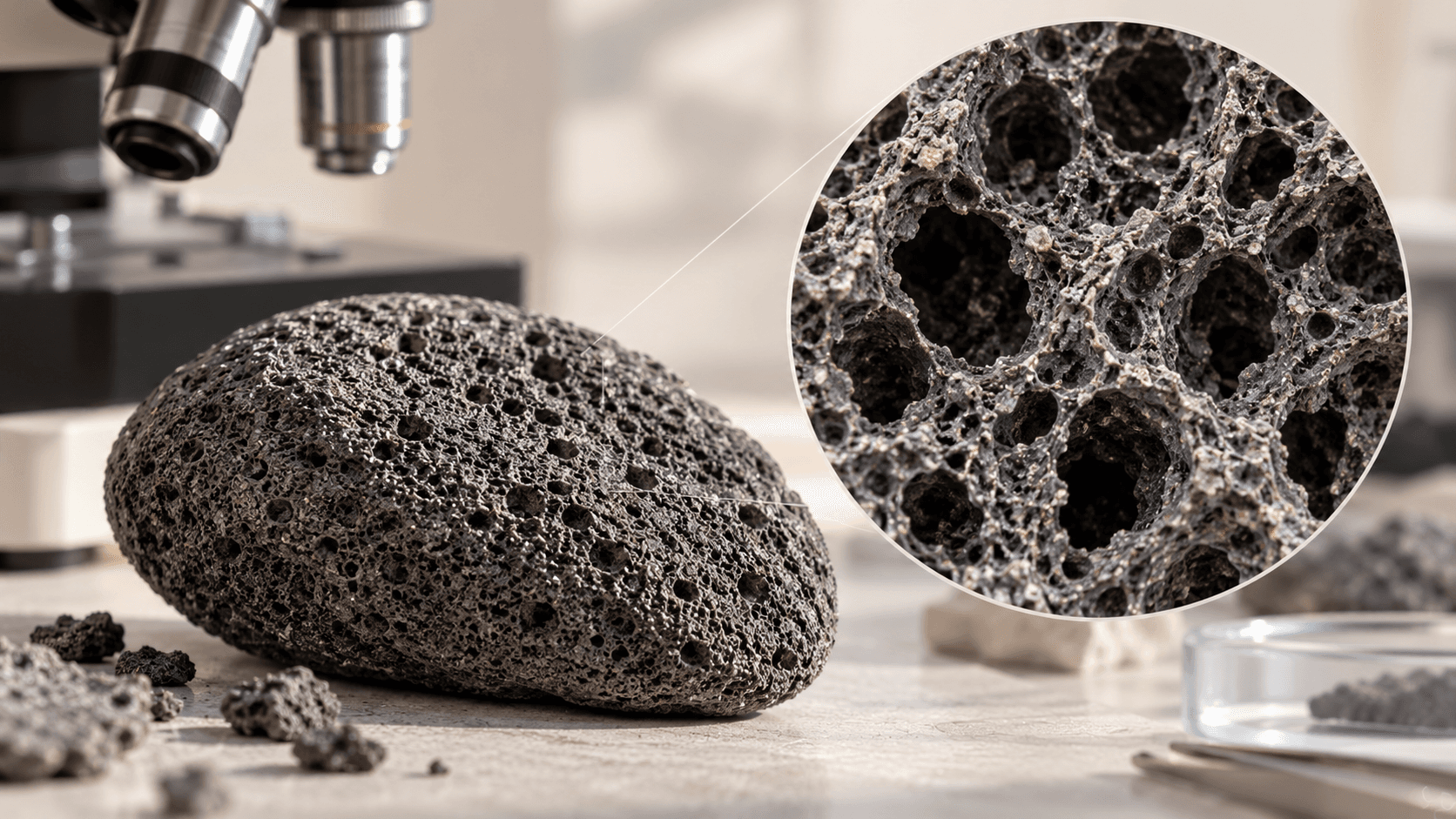
From naked-eye texture to a 50x view, natural pumice reveals irregular vesicles and glassy pore walls—useful evidence of structure, but not a stand-alone proof of origin.
Look at a pumice stone closely and you will see holes. Put the same stone under magnification and those holes become a record of a volcanic event: gas bubbles expanded in molten rock, walls stretched and cooled, and a foamy mass became solid volcanic glass.
That is what makes pumice under a microscope so compelling. Magnification can reveal a natural pumice structure that is hard to appreciate with the naked eye—uneven vesicles, thin glassy walls, changing pore sizes, and occasional mineral grains. It can also help you compare a natural volcanic pumice stone with a manufactured cellular abrasive. But it cannot, by itself, certify where a retail stone came from. The most trustworthy conclusion combines visible structure with clear material documentation from the seller or manufacturer.
This guide explains what to look for at ordinary macro and microscope magnifications, what a broken cross-section may reveal, and how to interpret those observations without turning them into a one-image authenticity test.
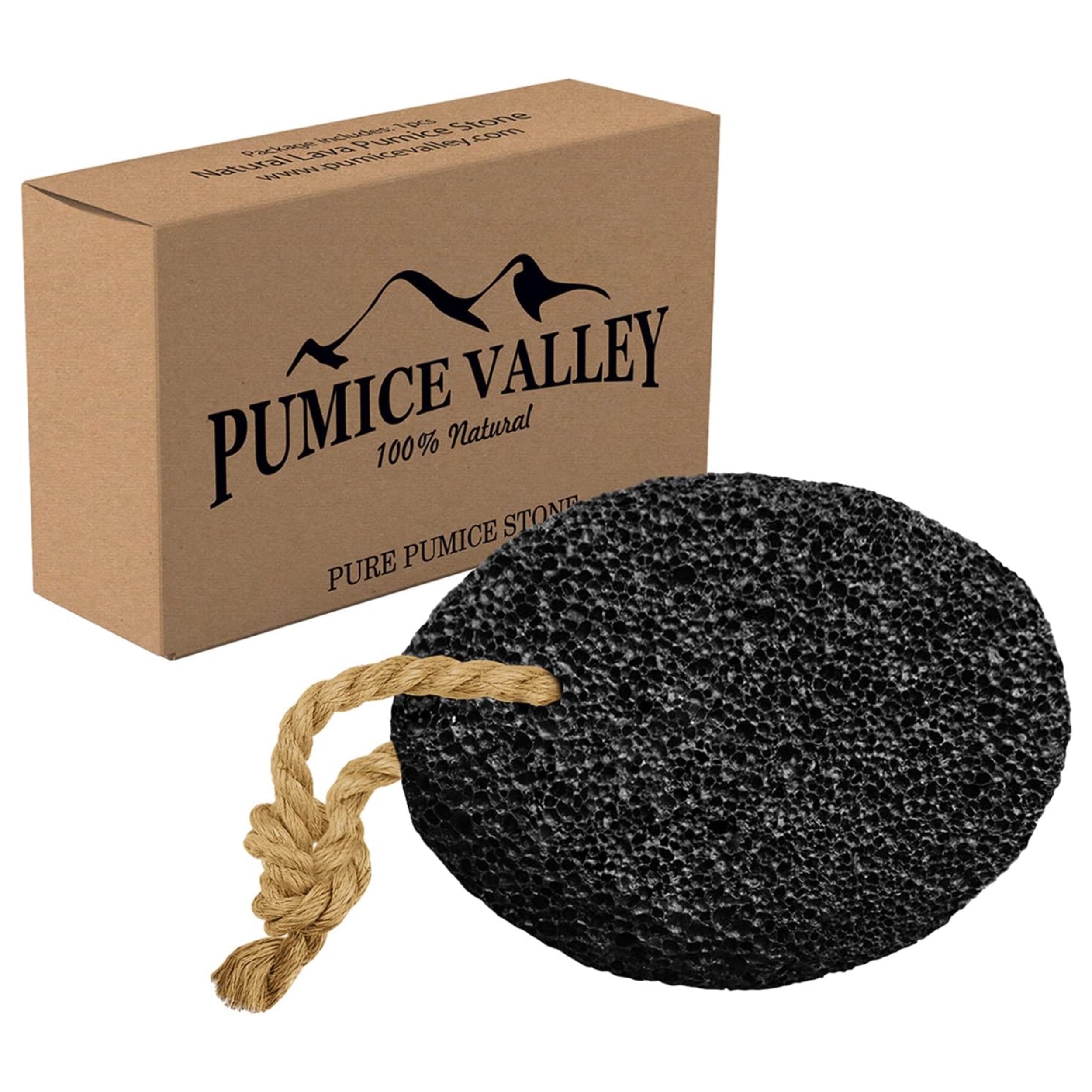
Pumice Valley original-photo placeholder — Whole stone
[Insert original photo: one dry, uncoated natural volcanic pumice stone on a neutral background, with a ruler or coin for scale. Alt text: “Whole natural volcanic pumice stone showing irregular pores and shape.”]
First: why volcanic pumice has pores
Natural pumice is formed by volcanic activity. Deep underground, molten rock can hold dissolved gases. As the magma rises and pressure drops, gases come out of solution and form bubbles—much as a carbonated drink fizzes when opened. If that frothy material is cooled and solidified quickly during an eruption, the former bubbles remain as cavities called vesicles.
USGS describes pumice as magma that has been frothed by escaping gases and then cooled and solidified during eruption [1]. The rock is largely volcanic glass, though it can also contain mineral crystals. Its pores lower the material’s bulk density and create the textured surface associated with a volcanic pumice stone.
The important visual point is that this is not a mold pattern. Bubble growth, flow, pressure, cooling, and the presence of crystals can all affect the developing structure. That is why real pumice stone texture can be mixed rather than perfectly repetitive.
1. What pumice looks like with the naked eye
At arm’s length, natural pumice usually reads as a light, porous rock. You may see a mixture of pinprick pores, larger openings, shallow pits, ridges, and broken edges. Colors can range across pale gray, cream, tan, brown, or darker shades depending on composition, weathering, and the deposit. Color alone does not prove origin.
Move the stone under angled light. This makes its relief clearer: some openings are rounder, some elongated, and some appear partly covered by thin walls. The outer surface may also have been cut, trimmed, or smoothed after extraction, so it is not always the best place to judge the internal material.
A naturally irregular appearance is a useful clue, but it is not absolute proof. A manufactured abrasive can be made to look porous, and a natural piece can be cut into a neat retail shape. At this scale, use your observation to ask better questions—not to deliver a verdict.
Pumice Valley original-photo placeholder — Macro pore structure
[Insert original photo: oblique-lit close-up of the stone surface, showing pores of multiple sizes. Alt text: “Macro view of irregular volcanic pumice pores and thin pore walls.”]
2. At 5x–10x magnification
A jeweler’s loupe, clip-on phone macro lens, or simple stereo microscope makes the natural pumice structure easier to read. At 5x–10x, look across a reasonably broad area instead of concentrating on one striking hole.
You may notice:
- pores with different diameters and shapes;
- curved, stretched, or partly merged openings rather than an exact grid;
- walls that change in thickness;
- small chips and fracture edges that reveal the material extends below the surface;
- tiny reflective points that may be mineral crystals or glassy surfaces.
These variations reflect a vesicular volcanic material. USGS work on pumice from the Pinatubo eruption documents examples with large vesicles interconnected along flow structures and others with smaller, more isolated vesicles [2]. In other words, even within natural pumice, one “look” is not the only look.
At this level, compare more than one area and, if possible, more than one stone. A real stone may be more open in one section and finer-textured in another. This broad variability can be consistent with volcanic formation. It is still not conclusive: an engineered foam-like abrasive can also contain pores, and surface wear can change what you see.
3. At 20x–50x magnification
At 20x–50x, a stereo microscope or digital microscope brings the walls and connections between vesicles into much sharper focus. Rather than seeing a “sponge,” you may begin to see a network of cavities separated by thin, irregular glassy material.
Look for these features:
Uneven vesicle geometry
Some cavities may be nearly rounded; others can be oval, drawn out, angular after breakage, or connected by narrow passages. Vesicles formed while the molten material moved and expanded, so their geometry need not be uniform. Their shape can preserve clues about bubble growth and flow, but a consumer should not try to identify a source volcano from a microscope image.
Variable wall thickness
Natural pumice commonly has walls that look thick in one place and delicate in another. Where a wall has fractured, its sharp, glassy-looking edge may catch the light. USGS notes that abundant vesicles lower pumice density and that breaking vesicle walls can continually expose sharp abrasive edges [3]. That observation helps explain the material’s historic use as an abrasive; it is not a claim about how any individual product should perform on skin.
Connected and isolated pores
Some pores link up; others are enclosed or only partly open. This distinction affects how a stone takes on water and whether it may float. USGS explains that pumice can float when its bubble-like voids resist rapid water entry, while volcanic material with open, interconnected vesicles may not float [4]. Under magnification, a visible connection is useful context—but not a direct prediction of how every pore in the stone behaves.
Glassy matrix and occasional crystals
Pumice is often described as volcanic glass with vesicles, and it may contain embedded crystals. At modest magnification, a mineral grain can appear as a small opaque or reflective inclusion. Proper mineral identification needs more advanced methods such as thin-section petrography, so do not label every bright speck with confidence.
Pumice Valley original-photo placeholder — Microscope comparison
[Insert two original images at the same magnification: natural volcanic pumice on the left and a disclosed manufactured pumice-style abrasive on the right. Label each only with documented material information. Alt text: “Microscope comparison of irregular natural pumice vesicles and a manufactured cellular abrasive.”]
4. What a broken cross-section can reveal
A cross-section lets you see beyond the retail surface. If a stone has already broken during ordinary use or handling, inspect the fresh interior under side lighting or a microscope. You may see pores continuing through the material, walls changing thickness, and cavities that are not all aligned or identical.
This can be a better view of volcanic pumice pores than a dirtied or worn exterior. It may also reveal whether a color coating, surface treatment, or bonded outer layer is present. But a cross-section is not a consumer laboratory test. Many cellular manufactured materials are porous throughout, too.
Do not deliberately break a usable foot-care stone to authenticate it. The result could create sharp fragments, waste the product, and still leave uncertainty. If origin matters, a documented material claim is more useful than destroying a sample.
Pumice Valley original-photo placeholder — Broken cross-section
[Insert original photo: naturally broken pumice fragment, with the porous interior in focus and a scale bar. Alt text: “Broken cross-section of natural volcanic pumice showing pores extending through the stone.”]
5. How manufactured cellular materials may appear
The category “manufactured pumice-style abrasive” covers more than one material, so there is no single synthetic appearance. Some products may have a very consistent pore size, repeated cell geometry, uniform color, distinct binder-like areas, or a texture that looks similar from edge to edge. Those observations can be useful prompts to ask what the product is made from.
Still, appearance alone cannot settle it. Manufacturing can deliberately introduce irregularity, while natural pieces can be selected, shaped, and finished for a more consistent retail look. A close-up comparison should be framed honestly: it can show differences between those particular samples, not prove that every uniformly porous stone is synthetic or every irregular one is natural.
Material disclosure matters here. A responsible comparison names the documented material, keeps the image conditions matched, and avoids calling an unlabeled product “fake.” The goal is consumer understanding, not an unsupported accusation.
6. Why microscopy is useful—but should be paired with material documentation
Microscopy is powerful because it turns vague language like “rough” or “porous” into observable features: vesicle size, pore shape, wall thickness, fracture edges, and how those features vary across a stone. It can help you recognize why natural pumice stones never look exactly the same.
But it has limits. A 10x or 50x image does not identify mineral chemistry, trace an item through its supply chain, or prove that a product label is accurate. Geologists make stronger material determinations with methods such as petrographic thin sections, mineral analysis, and chemical testing, alongside geological context.
For a shopper, the sensible approach is to combine:
- a specific disclosure that the product is natural volcanic pumice;
- available information about material origin and sourcing;
- a porous, variable structure that is compatible with pumice;
- cautious observations of size-relative weight and water behavior; and
- the awareness that no single visual or viral test is definitive.
That combination is more meaningful than treating a microscope image as a certificate of authenticity.
See the structure, then ask for the story behind it
Magnification makes a volcanic process visible: gas became vesicles, vesicles shaped a porous glassy rock, and no two pieces necessarily developed in the same way. Pumice Valley values that visible natural variation instead of trying to make every stone look perfectly uniform.
We also believe structure should be paired with transparency. Explore Pumice Valley natural volcanic pumice to learn about the material’s origin, its naturally varied pores, and the evidence behind the product description.
FAQ
What are the holes in a pumice stone called?^
They are called vesicles—cavities formed when gases expanded in molten volcanic material as it cooled.
What does real pumice look like under a microscope?^
It often shows irregular pores, variable wall thickness and a glassy volcanic matrix, but appearance alone cannot prove origin.
Can a phone macro lens show pumice pores?^
A phone macro lens can reveal useful surface texture, though it cannot replace a controlled microscope examination or material documentation.
Are perfectly round pores proof that a stone is synthetic?^
No. Pore shape is only one clue; natural samples can contain locally rounded pores and manufactured materials can imitate irregularity.
Does natural pumice always have open pores?^
No. Pumice can have a mix of connected and isolated pores, which affects water behavior and visible texture.
Can microscopy tell where a pumice stone came from?^
Microscopy can support material assessment but does not establish a specific source without stronger documentation and analysis.
Why do some pumice stones look smoother than others?^
Natural variation, wear, cutting and different pore structures can all change the visible surface.