We Tested the Most Popular Ways to Spot Fake Pumice — Here’s What Actually Works
如何辨别真假浮石
We evaluated the most popular ways to spot fake pumice. Here is what float, weight, water, macro, and disclosure checks can—and cannot—tell you.
Search “how to tell fake pumice” and you will find confident rules: real pumice floats, fake pumice sinks; real pumice is light; real pumice has uneven holes. Each rule contains a small piece of useful science. None is enough to identify a stone on its own.
That is the problem with a viral pumice stone test. It turns a material question into a one-step trick.
This guide evaluates the most popular consumer checks against what geology can actually support. It is not a claim that Pumice Valley laboratory-tested every product on the market, nor is it an accusation that a particular seller’s product is fake. We reviewed each method as an evidence tool: what it can observe, where it can mislead, and how much weight it deserves when you are assessing a natural pumice stone.
The result in one minute
The most useful consumer evidence is a combination of clear material disclosure, meaningful origin information, irregular porous structure, and physical observations that make sense together. The weakest approach is declaring a stone natural or synthetic after one water test, one number on a scale, or one photo.
Natural volcanic pumice is highly vesicular volcanic ejecta—essentially gas-frothed magma that cooled and solidified during eruption.1 Those gas-bubble cavities, called vesicles, are why a natural stone can look and behave unusually light. But porous manufactured materials can also be light, absorb water, or float. Physical behavior describes a sample; it does not, by itself, document origin.
How we evaluated the tests
For this article, “works” means a test gives an observation that is relevant to material structure and remains useful when its limitations are stated. We used three ratings:
- Useful clue: adds meaningful evidence when paired with other checks.
- Weak clue: may be interesting, but has broad overlap between possible materials or conditions.
- Not reliable alone: can be misread so easily that it cannot settle an authenticity claim.
The protocol is intentionally consumer-safe and non-destructive unless noted. It does not substitute for petrography, compositional analysis, supplier records, or an independent materials laboratory. If a brand needs to make a verified origin claim, documentation and appropriate expert testing are stronger evidence than a kitchen experiment.
The scorecard: what each test can really tell you
| Test | What you observe | How useful it is | Main limitation |
|---|---|---|---|
| Visual pore inspection | Surface vesicles, wall shapes, irregularity | Useful clue | Surface alone does not identify composition or origin |
| Stone-to-stone uniformity | How similar several stones are | Weak clue | Natural stones can be cut; manufactured items can vary |
| Weight | Mass in the hand or on a scale | Weak clue | Size, moisture, and density differ from sample to sample |
| Approximate density | Mass relative to volume | Useful clue | Home volume measurements are imprecise for porous irregular objects |
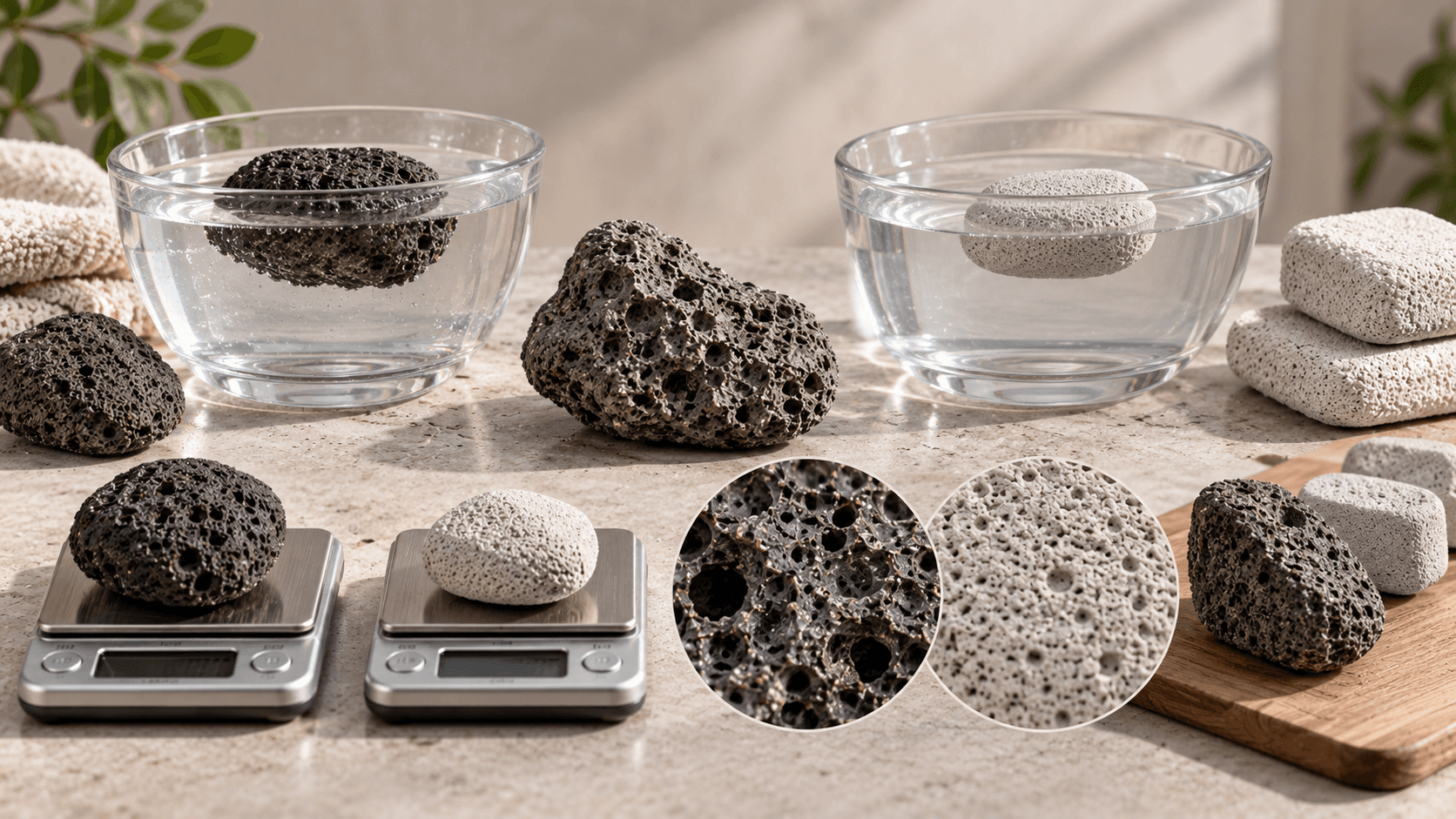
| Float test | Buoyancy and change over time | Weak clue | Floating does not prove volcanic origin; sinking does not disprove it |
| Water absorption | Change after controlled wetting | Weak clue | Prior moisture, coatings, and pore connectivity affect results |
| Macro photography | Enlarged visible surface texture | Useful clue | It reveals structure, not chemistry |
| Microscope examination | Pores and walls at higher magnification | Useful clue | It is not a mineralogical or provenance test |
| Breaking a sample | Fresh internal cross-section | Useful clue | Destructive; still not definitive without material analysis |
| Material/manufacturer disclosure | Specific statement of material and origin | Useful clue | The buyer must judge how well the claim is documented |
1. Visual pore inspection: start here, but do not stop here
Look at a dry stone in good daylight. Natural volcanic pumice often has a cellular surface with pores of different sizes and shapes, thin uneven walls, and variation across the same stone. Those features reflect gas escaping and expanding while lava cooled. USGS describes vesicles as cavities left when gases are released from lava as it hardens.2
This makes visual inspection a useful clue. A visibly irregular, porous volcanic-looking structure is more informative than a product name alone. It can also help you notice a surface that appears coated, molded, or unusually repetitive.
But a consumer cannot identify a rock’s composition from a photograph. Natural pumice may be cut or smoothed for a foot-care shape. Pores may be worn, clogged, or altered by use. Some manufactured abrasive blocks can be porous too. Describe what you see; do not leap from “irregular” to “proven natural.”
2. Stone-to-stone uniformity: variation is context, not proof
Line up several stones from the same product. Differences in pore size, contour, color, and apparent lightness can be consistent with natural material. Volcanic formation does not use a mold.
That makes uniformity a weak clue, not a verdict. A natural material can be sorted, trimmed, or cut to close tolerances. A manufactured material can be intentionally varied. One highly uniform set is not automatically a synthetic pumice stone, and one varied set is not automatically volcanic pumice.
Use this comparison to ask a better question: does the seller explain whether the stones are naturally occurring, shaped, or manufactured? Clear language about the material is more useful than visual sameness alone.
3. Weight: useful sensation, weak evidence
Natural pumice often feels light for its size because much of its volume can be vesicles rather than solid volcanic glass. However, mass by itself tells you almost nothing unless you also know volume, dryness, and structure.
Two equal-size natural stones may weigh differently because their porosity differs. A wet stone can weigh more than when dry. Two objects with the same mass can have very different volumes and therefore very different densities. A porous manufactured abrasive can also feel light.
Rate a simple scale reading as a weak clue. Avoid rules such as “real pumice weighs X grams.” There is no universal gram threshold for a product whose dimensions and natural pore structure vary.
4. Approximate density: better than weight, still not a home verdict
Density is mass divided by volume. It is a more meaningful comparison than weight because it accounts for size. If two dry, similarly sized stones are compared, the lighter one has lower bulk density. That may be consistent with higher pore volume—but it does not name the material.
For an approximate comparison, weigh each dry stone, then estimate volume from dimensions if it is a regular shape. For an irregular stone, water displacement is tempting, but open pores can take in water and make the result difficult to interpret. Researchers use controlled methods to measure bulk, skeletal, and solid density in porous volcanic rocks; a kitchen glass is not the same measurement.3
This earns useful clue status only when you compare similarly sized, dry samples and report it modestly: “this sample appears lower-density under this method,” not “this proves it is real.”
5. Float test: memorable, but far from decisive
Pumice can float when its overall density is below water and gas-filled pores remain protected from rapid water filling. USGS also gives an important exception: exceptionally vesicular reticulite does not float when its open, interconnected vesicles rapidly admit water.4
So the float test is a weak clue. A natural pumice stone may float at first, float for a long time, partly submerge, or sink. A porous manufactured product may float too. A stone’s prior moisture, pore connectivity, damage, water temperature, salinity, and whether someone pressed it underwater can change the outcome.
If you try it, place a dry stone gently in room-temperature tap water without pushing it down. Record its behavior at the start, after five minutes, and after 24 hours. Treat the result as information about buoyancy and pore behavior—not proof of whether it is a real vs fake pumice stone.
6. Water absorption: an observation with many variables
Water absorption is related to open pore space, but it is not a simple natural-versus-synthetic test. Pumice can have isolated pores, connected pores, and dead-end pores. Water may enter some parts of the network quickly and others more slowly. Research on pumice flotation finds that pore connectivity and trapped gas affect infiltration and buoyancy.5
For a simple observation, photograph and weigh a dry sample, soak it under the same conditions as a comparison sample, blot the surface consistently, and note any visible darkening or change. Do not make a percentage-absorption claim from a casual kitchen test.
Rate it a weak clue. Previous soaking, coatings, fractures, and incomplete drying can overwhelm the comparison. Absorption can complement close structure inspection, but it does not identify the material.
7. Macro photography: a repeatable way to look closer
Use a phone’s close-focus mode, a clip-on macro lens, or a high-resolution camera in diffuse daylight. Photograph the whole stone, then the same-sized area on several stones. Include a ruler or other scale reference. Look for pore-size variation, irregular junctions between pores, and changes from one region to another.
Macro photography is a useful clue because it makes visual comparisons repeatable and shareable. It can reveal details the naked eye misses without altering the sample. It is especially useful for documenting the results of other observations.
Its limit is fundamental: magnification does not turn a photo into a composition test. Keep captions accurate: “visible pore pattern,” not “proof of natural volcanic origin.”
8. Microscope examination: stronger structure evidence, not a certificate
At low magnification, natural pumice may show a complex network of cavities and irregular walls of volcanic glass. At higher magnification, pore shape, connection, wall thickness, and inclusions can be more apparent. These are real geological features worth observing.
Microscopy is a useful clue because it offers more structure information than a product photo. It becomes more valuable when observations are compared with known reference material and interpreted by someone trained in geological materials.
Still, a consumer microscope cannot usually establish mineral chemistry, volcanic source, or manufacturing history. Even professional texture studies distinguish between bulk density, porosity, connectivity, and vesicle texture rather than relying on one visual feature.6
9. Breaking a sample: see inside, only if you can sacrifice it
A fresh cross-section can show whether the porous structure continues through the interior rather than appearing only at the surface. In pumice, a broken face may reveal irregular vesicles across the sample. This can be more informative than inspecting a worn exterior.
Call it a useful clue, with serious limits. The test is destructive, can create sharp fragments, and is unnecessary for a stone intended for use. Wear eye protection, contain fragments, and do not perform it around children. Most important: an internal porous pattern is still not complete authentication. Other porous materials can have interior cells.
For content or quality-control work, a non-destructive macro or microscope comparison is usually the better first step.
10. Material and manufacturer disclosure: the evidence most people skip
The strongest consumer starting point is often the least dramatic. Does the product description explicitly say “natural volcanic pumice”? Does it identify the material rather than only using “pumice” as a product category? Does the seller provide source or sourcing information and answer material questions directly?
Rate clear disclosure a useful clue—and ask whether it is supported by credible documentation. A label is not laboratory analysis, but transparent sourcing connects a physical item to a claim in a way a float test cannot. Ecommerce vocabulary can be inconsistent, so request clarification instead of assuming that every “pumice” listing means the same thing.
For brands, the standard should be simple: say what the stone is, avoid absolute promises that the material cannot support, and explain why naturally sourced pieces may vary.
A practical consumer protocol
If you are comparing samples, use a small checklist rather than chasing a single reveal:
- Read the material claim and look for origin information.
- Photograph each dry stone in the same light with a size reference.
- Compare visible pore structure and stone-to-stone variation.
- Compare mass only among similarly sized, fully dry stones.
- If you conduct a float or water observation, use the same water, container, timing, and method for every sample.
- Record uncertainty: “supports,” “does not support,” or “inconclusive” is more honest than “proved.”
- When the claim matters commercially or scientifically, request documentation or seek an appropriate independent materials expert.
This protocol also prevents a common content mistake: showing a single dramatic result without describing the starting conditions.
The responsible conclusion
The float test, scale test, and close-up photo all have a place when they are treated as clues. The most convincing consumer picture emerges when documented origin and specific material disclosure agree with a naturally irregular, porous structure and sensible physical behavior.
The best evidence is not one viral test. It is the combination of origin, structure, material disclosure and physical characteristics.
Pumice Valley chooses natural volcanic pumice and aims to be transparent about the material rather than asking you to trust a trick. Explore the stone’s origin and visible structure before choosing what you exfoliate with.
Footnotes
-
U.S. Geological Survey, Volcano Hazards Program Glossary, “Pumice.” ↩
-
U.S. Geological Survey, “Find-A-Feature: Vesicles.” ↩
-
Takeuchi, S. et al. (2026). “Bulk, skeletal, and solid density measurements for porous volcanic rocks using a simple water-displacement method.” Earth, Planets and Space. ↩
-
U.S. Geological Survey, Eruptions of Hawaiian Volcanoes, “Pumice and reticulite.” ↩
-
Kawasaki, K., & Takeuchi, S. (2025). “Pumice flotation time: how does the infiltration of water progress inside pumice?” Progress in Earth and Planetary Science, 12, 38. ↩
-
Jutzeler, M. et al. (2021). “Sink or float: microtextural controls on the fate of pumice deposition during the 2012 submarine Havre eruption.” Bulletin of Volcanology, 83, 47. ↩
FAQ
How can I tell fake pumice from real pumice?^
No single home test is definitive. Combine clear material disclosure, origin information, irregular porous structure, and physical observations; seek documentation or expert analysis when certainty matters.
Does real pumice always float?^
No. Natural pumice may float, sink, or change behavior as water enters its pore network. Sinking does not prove a stone is synthetic.
Is a perfectly shaped pumice stone fake?^
Not necessarily. Natural pumice can be cut or shaped, so shape alone does not identify the material.
Can synthetic pumice stone float?^
Yes. A porous manufactured material may contain enough air-filled space to float, so buoyancy does not prove volcanic origin.
Does a microscope prove pumice is natural?^
No. Microscopy offers structural clues but does not establish composition, source, or manufacturing history by itself.
Why do natural pumice stones look different?^
Natural variation in gas bubbles, cooling, porosity, and later shaping can change appearance from stone to stone. Variation alone is not proof of authenticity.
What is the most reliable question to ask a seller?^
Ask whether it is natural volcanic pumice, where it is sourced, and what documentation supports that claim.