Natural Pumice vs Synthetic Pumice: What’s the Difference?
有什么区别
Natural volcanic pumice and manufactured pumice-style abrasives can look similar, but their origins and structures differ. Learn what shoppers can observe, what home tests cannot prove, and how to evaluate material claims.
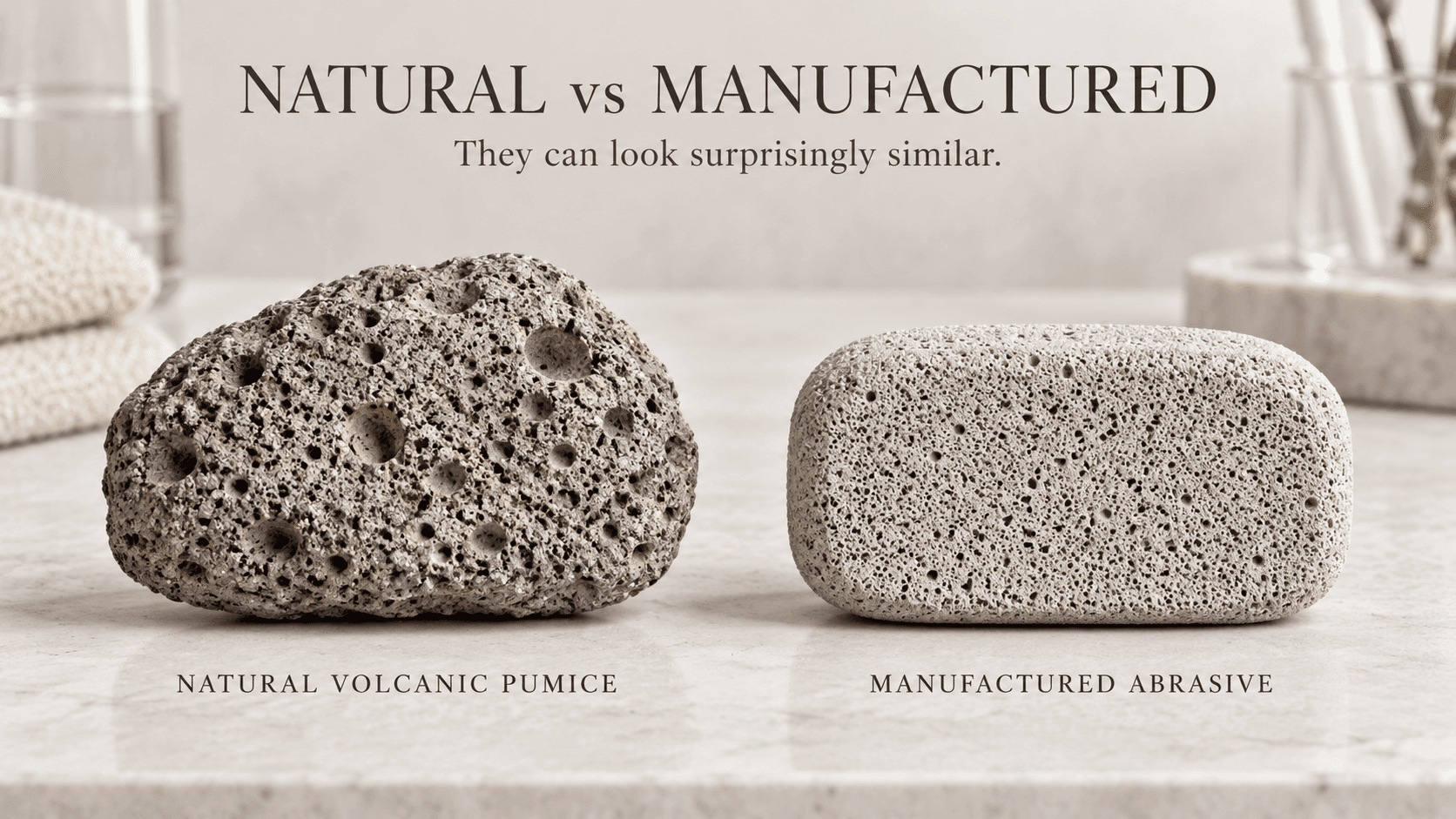
When a foot-care listing says “pumice,” it is easy to assume every stone began the same way. It did not. A natural pumice stone is a porous volcanic rock. A product described as a pumice stone can also be a manufactured abrasive block or a different engineered cellular material designed to do a similar job.
That distinction is not a simple good-versus-bad choice. Natural volcanic pumice varies from piece to piece; manufactured pumice-style abrasives are often designed for consistency. The useful question is: what is it, and does the seller explain it clearly?
This guide compares natural pumice vs synthetic pumice and explains what appearance alone cannot prove.
The short version
Natural volcanic pumice is a lightweight, porous rock made when gas-rich magma erupts and cools quickly. Manufactured pumice-style blocks are industrially made abrasives whose ingredients and methods vary. “Synthetic pumice” is consumer shorthand, not a precise geological classification; check the material disclosure.1
What is natural volcanic pumice?
Pumice is a volcanic rock made largely of volcanic glass and marked by abundant vesicles—cavities left by expanding gas bubbles. During an explosive eruption, pressure drops and gases dissolved in magma can come out of solution. Rapid cooling helps preserve that bubbly structure before the material can collapse into a denser rock.1
Those vesicles are part of the stone’s interior architecture. A cut or broken section may show different pore sizes, thin walls, merged cavities, and connected pathways. Geological studies document substantial differences in vesicularity, permeability, and pore connectivity even among samples from the same eruption.2
That origin gives natural pumice stone for feet an irregular mineral-and-glass working surface.
What do people mean by “synthetic pumice”?
In consumer shopping, “synthetic pumice stone” usually means a manufactured abrasive product that resembles a pumice stone in shape or intended use. It is not necessarily trying to impersonate a volcanic rock, and it is not automatically inferior or unsafe. It may simply be engineered to provide a repeatable size, texture, grip, or rate of wear.
Ecommerce listings may use pumice, pumice-like, pedicure stone, abrasive block, or synthetic pumice inconsistently. A title, color, or product photo is weak evidence of origin. Look for a direct material statement and, where available, origin information. If it is absent, ask the seller rather than assuming deception.
Natural pumice vs synthetic pumice at a glance
| Characteristic | Natural volcanic pumice | Manufactured pumice-style abrasive stone |
|---|---|---|
| Origin | Formed in a volcanic eruption from vesicular, rapidly cooled magma | Made by an industrial process; composition and method vary by product |
| Pore structure | Often irregular in size, shape, spacing, and connectivity | May be engineered for a more repeatable cellular pattern or surface; not universal |
| Piece-to-piece consistency | Can vary noticeably, even within one source deposit | Often more uniform in dimensions and texture, depending on manufacturing |
| Density and weight | Controlled by volcanic glass, pore volume, pore connectivity, and moisture | Controlled by its particular formulation and structure; cannot be inferred from the label “synthetic” |
| Water behavior | May absorb water through connected pores; some pieces float temporarily and some may sink | Water behavior varies with material and open/closed pore structure |
| Surface feel | Irregular abrasive points and edges may change as the stone wears | Can be formulated for a relatively predictable feel or wear pattern |
| Material verification | Geological origin and a truthful material disclosure are strongest evidence | A complete material disclosure is the clearest way to know what it is |
The table describes tendencies, not authenticity tests. A uniform-looking stone can be natural pumice that was cut into a standard shape. An irregular-looking block can be manufactured. No single feature settles the question.
Pore structure: the biggest physical difference
Natural pumice owes its texture to vesicles formed by volcanic gases. At a macro scale, you may see tiny pinpricks, larger cavities, stretched openings, and broken walls. Under magnification, the network can record bubbles growing, merging, deforming, and freezing in place as molten material cooled.
That variation has a scientific basis. Research on pumice from Oregon’s Mount Mazama found differences in vesicularity, permeability, and interconnected pore volume between material from different parts of the same climactic eruption.2 Other studies describe multiple vesicle-size populations in pumice formed during explosive eruptions.3 In practical terms, a real pumice stone may have one smoother face, one more open face, or patches that feel different from one another.
Manufactured cellular abrasives may also have pores, but their pattern and composition arise from their production method. Some may look impressively regular; others may be deliberately roughened or varied. A consumer cannot reliably identify the chemistry or manufacturing process merely by looking through a phone macro lens.
Can you tell just by looking?
Sometimes you can gather useful clues. You cannot get a conclusive answer from looks alone.
A natural volcanic pumice stone may show uneven pore sizes, irregular contours, natural color variation, thin glassy-looking walls, and a less repetitive pattern across the surface. A manufactured abrasive block may have cleaner edges, a repeated shape, or more even cell spacing. But each observation has exceptions:
- Natural pumice can be cut, shaped, washed, or tumbled for retail, making its outline look neat.
- Natural pumice from different volcanic settings can range from very fine-pored to visibly open, and from pale to gray, brown, or dark.
- Manufactured products can be colored, textured, or formulated to look irregular.
- Lighting, moisture, and surface dust can change what a photo suggests.
Treat visual inspection as the beginning of a material check. Combine it with clear product documentation and, if needed, several physical observations.
Density, weight, water absorption, and floating
Natural pumice is often light for its size because its many vesicles reduce its bulk density. USGS material describes pumice fragments in volcanic ash as commonly around 700–1,200 kg/m³, while also stressing that density varies by particle type and moisture.4 This is useful geological context, not a home-authentication threshold for a retail stone.
Two equally sized pieces of natural pumice can have different weights because they contain different amounts of solid glass, different pore volumes, and different degrees of connected porosity. A dry stone and a water-saturated stone can also weigh very differently. Conversely, a manufactured porous abrasive can be lightweight too.
Water behavior is equally nuanced. Connected pores can take in water. USGS explains that low-density pumice can form floating mats, yet also notes that pumice with connected voids may fill with water and sink, while less-connected voids can support longer floating.5 So a float test is a clue about density and pore behavior under those conditions—not proof that a stone is real or fake.
If you compare stones at home, compare similarly sized, dry samples and record their dimensions, mass, water uptake, and visible structure. The pattern of evidence is more meaningful than a single number or a quick dunk in a glass.
Surface texture and use during foot exfoliation
Both natural and manufactured pumice-style tools are abrasives. The important practical variables are the surface coarseness, the pressure you use, the condition of the skin, and how cleanly the tool can be maintained—not simply whether the product is natural.
Natural pumice can present changing high points and pores as it wears. That may feel pleasantly varied to someone who likes a traditional stone. A manufactured abrasive may offer a more predictable surface from one unit to the next, which some people prefer for repeatability or a specific shape. Neither label tells you exactly how aggressive it will feel.
For cosmetic smoothing, start gently on softened skin and stop if skin feels tender or irritated. Do not use an abrasive tool on broken, bleeding, infected, or painful skin. People with diabetes, poor circulation, neuropathy, reduced sensation, or healing concerns should seek individualized clinical advice first.
Durability and care
Natural pumice can wear, chip, or gradually change texture because it is porous. A manufactured abrasive may be engineered for a more consistent wear pattern, but this depends on formulation and bonding—not the word synthetic alone.
For either material, rinse away visible debris after use, wash according to the maker’s instructions, and dry it fully in an open, ventilated place. Do not share it. Replace a tool if it is difficult to clean, has an odor, is breaking down excessively, or has an abrasive surface you can no longer use comfortably.
Environmental considerations: avoid the easy story
“Natural” does not automatically mean lower impact, nor “manufactured” higher impact. A fair comparison needs product-specific information about extraction, processing, transport, packaging, lifespan, and disposal. Without comparable life-cycle data, transparency about material origin is more useful than a blanket sustainability verdict.
Why natural pumice stones don’t all look the same
Nature does not use a mold. Gas content, pressure, cooling rate, mineral content, bubble coalescence, and the portion of a volcanic deposit from which a piece came can all affect a pumice stone’s texture and density. A stone may also be trimmed after extraction, creating a consistent retail shape while retaining an irregular internal structure.
That is why one natural pumice stone for feet may be pale and fine-pored, while another is darker, more open, or a little heavier at the same size. Variation is expected in volcanic material—but it is not proof of authenticity by itself. Material disclosure and origin information remain important.
How to shop more confidently
Use these questions to move beyond marketing shorthand:
- Does the seller explicitly identify the material as natural volcanic pumice or disclose that it is manufactured?
- Is there an origin or sourcing description, rather than only the word “pumice” in a product title?
- Are product photos consistent with a porous stone, without being treated as the only evidence?
- Does the brand acknowledge normal stone-to-stone variation instead of promising impossible uniformity from a natural material?
- Can the seller answer a straightforward question about composition, care, and intended use?
Clear answers matter more than a viral float test or a vague “100% real” badge.
A transparent material choice
Natural volcanic pumice has a history written into its pores: expanding gas, rapidly cooled volcanic glass, and real variation from one stone to the next. Manufactured pumice-style abrasives have their own legitimate place when a consistent engineered tool is what a shopper wants.
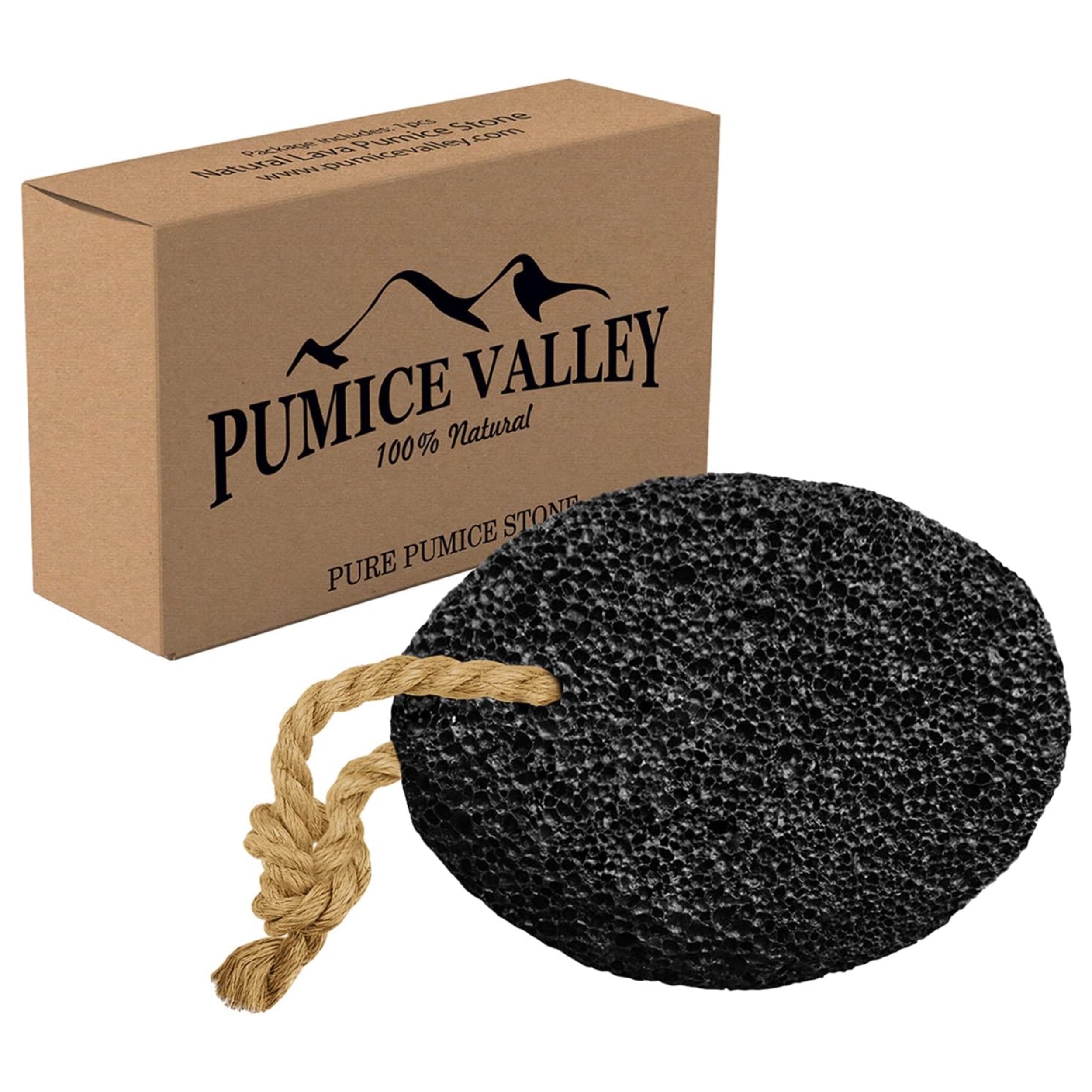
Pumice Valley chooses natural volcanic pumice and believes shoppers deserve a clear explanation of what that means—not a simplistic promise based on one test. Explore how our stones’ volcanic origin and visible structure shape the material you use.
Footnotes
-
U.S. Geological Survey, Pumice, describing abundant vesicles in volcanic pumice and their effect on porosity and density. ↩ ↩2
-
Klug, C., Cashman, K., & Bacon, C. R. (2002). “Structure and physical characteristics of pumice from the climactic eruption of Mount Mazama (Crater Lake), Oregon”, Bulletin of Volcanology, 64, 486–501. ↩ ↩2
-
Sparks, R. S. J., & Brazier, S. (1982). “New evidence for degassing processes during explosive eruptions”, Nature, 295, 218–220. ↩
-
U.S. Geological Survey, “Impacts & Mitigation — Density & Hardness”. ↩
-
U.S. Geological Survey, Nature and Composition of Tephra, discussion of pumice density, floating, and water filling connected voids. ↩
FAQ
Is natural pumice better than synthetic pumice for feet?^
Not automatically. Natural pumice offers an irregular volcanic texture, while manufactured tools may offer more consistency. Choose a tool you can use gently and whose material is clearly disclosed.
What is a synthetic pumice stone made of?^
There is no single answer. The phrase can describe different manufactured porous or abrasive products, so read the individual product’s material information or ask the seller.
Can synthetic pumice look like real pumice stone?^
Yes. Appearance can provide clues, but color, pores, and an irregular outline do not conclusively establish geological origin.
Does a volcanic pumice stone always float?^
No. Many pumice pieces can float because of low density, but connected pores can fill with water and some natural pumice may sink. Floating alone does not authenticate a stone.
Why is one natural pumice stone heavier than another?^
Pore volume, mineral content, size, pore connectivity, and absorbed moisture can all change weight. Compare similar dry stones rather than relying on one grams-based rule.
Is a perfectly shaped pumice stone synthetic?^
Not necessarily. Natural pumice can be cut or shaped after extraction, so a neat outline is not enough to identify a material.
Is natural pumice more sustainable?^
Natural origin alone is not a complete environmental assessment. A fair comparison needs product-specific information about sourcing, processing, transport, lifespan, and disposal.
How can I tell whether a listing uses natural volcanic pumice?^
Look for an explicit material statement, origin details, and a seller willing to explain the product. Use visible structure and water behavior only as supporting clues.