Is Your Pumice Stone Actually Natural? How to Tell Real Volcanic Pumice From Manufactured Alternatives
天然浮石
A pumice stone's look, weight and float behavior can offer clues, but no single home test proves its origin. Learn how to assess natural volcanic pumice with more transparency.
A pumice stone can look like a simple foot-care tool: light, porous, and rough enough to smooth hardened skin. But “pumice stone” is used loosely in product listings. Some products are genuine natural volcanic pumice. Others are manufactured abrasive blocks designed to do a similar job. Neither label automatically tells you how a particular product will feel or perform; it does tell you something important about its material origin.
The most honest answer to “how to tell if pumice is real” is this: no single kitchen-table test can prove it. A good assessment combines the seller’s material disclosure with several physical clues—especially structure, variation, density, and how the stone interacts with water. This guide explains what those clues can, and cannot, tell you.
What is natural pumice?
Natural pumice is a volcanic rock. It forms when gas-rich molten rock rises and loses pressure, allowing dissolved gases to form bubbles. If that frothy material cools and solidifies quickly, the bubbles are preserved as cavities in a glassy volcanic material. Geologists call those cavities vesicles. The U.S. Geological Survey describes pumice as magma “frothed up” by escaping gases and then cooled and solidified during eruption [1].
That history matters because it creates a cellular structure rather than a perfectly engineered one. In a natural pumice stone, bubble size, bubble shape, wall thickness, and connectedness can change from one area to another. A stone may have rounder pores, stretched pores, fine pores, or a mixture. It may also contain small mineral crystals or denser patches. Those are normal consequences of an eruption, cooling, breakage, and later cutting or shaping.
For a pumice stone for feet, the useful surface comes from this porous, abrasive structure. As it wears, new edges and pores may be exposed. That does not mean every natural stone will feel identical, or that a manufactured alternative cannot be effective. It means the underlying material is different.
Why the label can be confusing
In geology, pumice is a naturally formed volcanic rock. In commerce, shoppers may see phrases such as “pumice,” “pumice-like,” “pedicure stone,” “lava stone,” “abrasive block,” or “synthetic pumice stone.” A listing may clearly name natural volcanic pumice; another may describe texture and function but not material. Terminology is not always consistent across ecommerce listings.
Manufactured abrasive stones can be made from various materials and processes. Some are ceramic or glass-based cellular abrasives; others may be composite or molded abrasive products. Their pore pattern, density, color, and water behavior depend on their formula and manufacture. They are not inherently bad, and a natural-looking surface does not establish provenance. The practical point is transparency: the most direct evidence is a credible, specific disclosure of what the product is made from and, when available, where its natural material was sourced.
Natural volcanic pumice vs. manufactured abrasive stone
| Characteristic | Natural volcanic pumice | Manufactured pumice-style abrasive stone |
|---|---|---|
| Origin | Volcanic rock formed during an eruption | Made through an industrial material and production process |
| Pore pattern | Often irregular and variable, reflecting volcanic bubbles | May be more uniform or repetitive, depending on the process |
| Shape and color | Can vary naturally; may also be cut into a regular retail shape | Can be made to a consistent shape, color, and texture |
| Density and water behavior | Varies with pore volume and whether pores connect | Varies by material and design; cannot be predicted from the category alone |
| Best evidence of identity | Material/origin documentation plus compatible physical characteristics | Clear manufacturer disclosure plus compatible physical characteristics |
This comparison describes patterns, not verdicts. Natural stone can be cut into an even oval or rectangle. A manufactured stone can have irregular-looking pores. Material analysis and supply-chain documentation are stronger evidence than appearance alone.
5 Things to Look For in a Natural Pumice Stone
1. A clear material and origin statement
Start with the information that is hardest to learn from a photo: does the seller explicitly identify the product as natural volcanic pumice? Do they explain its origin or provide meaningful material details rather than only marketing adjectives? Specific, consistent documentation is more useful than a viral home test.
This is still not laboratory proof on its own. But a transparent statement, supported by a coherent product description and the physical clues below, is a sensible place to begin. If a listing does not disclose the material, it is reasonable to ask before buying rather than assuming.
2. An irregular cellular structure
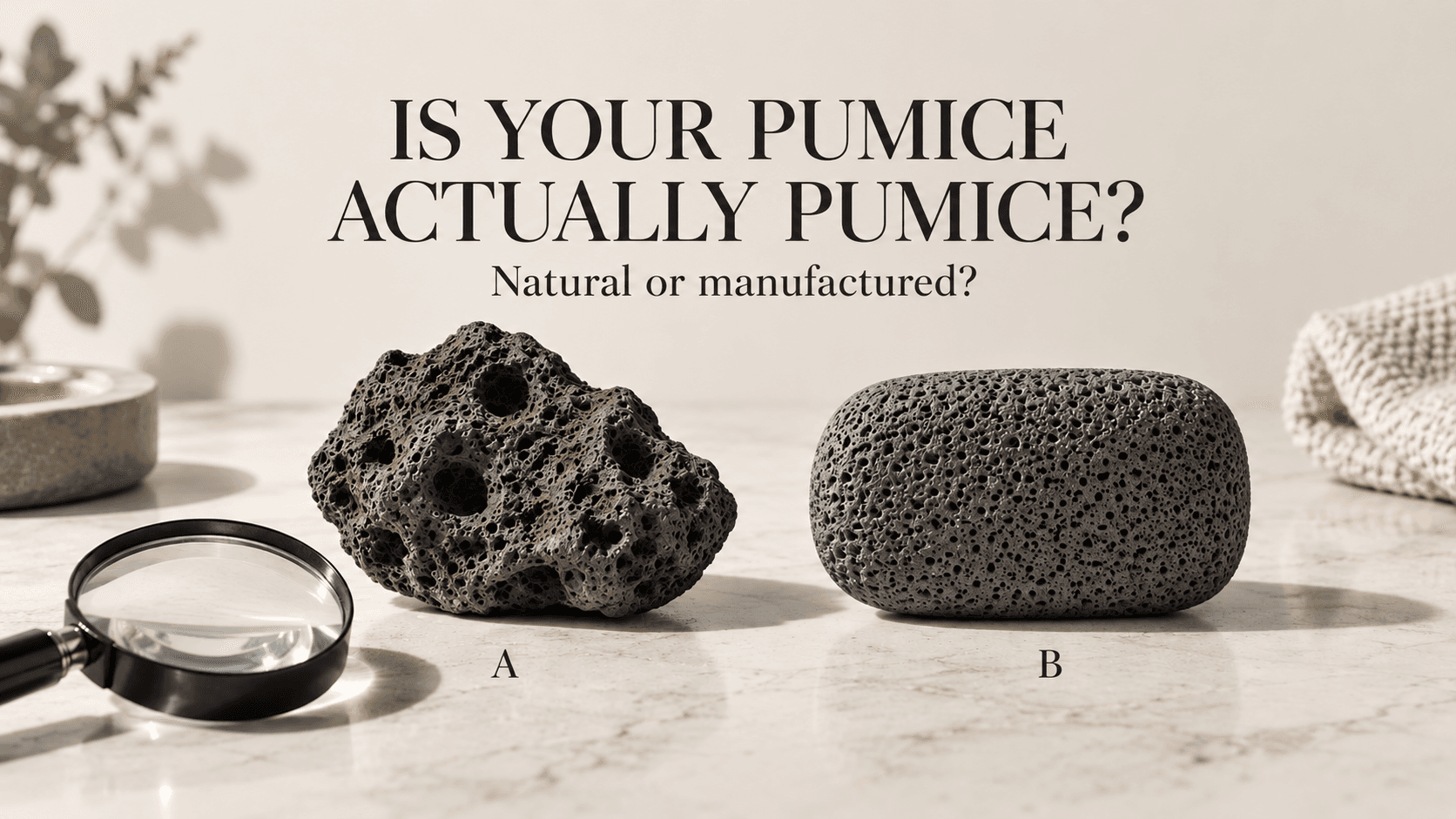
Look closely at the pores. Natural volcanic pumice often has a mixed, cellular-looking structure: some openings are larger, some smaller, and their shapes may not repeat in a tidy grid. On a broken or uncoated edge, the variation may be easier to see than on a retail-cut exterior.
The reason is geological. Gas bubbles expand and deform while molten material moves and cools. USGS examples from the Pinatubo eruption show pumice with different vesicle sizes and with either interconnected or more isolated vesicles [2]. Irregularity is therefore a useful clue—not proof. A manufacturer can design a varied surface, and one fragment of natural pumice may happen to look fairly even.
3. Variation from stone to stone
If you compare several natural pumice stones, expect differences in pore size, color, profile, and weight. The stones may come from different portions of a deposit and may be cut to a similar format afterward. Variation fits a natural material; it does not prove one.
Uniformity also deserves careful interpretation. A retail brand can select, sort, trim, or shape natural stones for consistency. Conversely, engineered products can be intentionally irregular. Treat stone-to-stone variation as supporting context, not a pass/fail test.
4. Low apparent density for its size
Pumice may feel light because its many vesicles reduce its bulk density. The word density is more informative than weight alone: it is mass relative to volume. A small stone can weigh little because it is small; a larger natural stone can weigh more simply because it contains more material.
Published pumice samples illustrate how variable this can be. One USGS report gives average bulk densities of 0.82 and 0.98 g/cm³ for two Pinatubo pumice types [3], while another study reports a single sample at 0.66 g/cm³ [4]. These are geological samples, not a consumer specification or an authenticity threshold. Natural pumice can differ substantially in porosity, mineral content, pore connectivity, and absorbed moisture.
Compare similar-size, dry stones rather than relying on “real pumice weighs X grams.” A surprisingly light feel can support the natural-pumice story; it cannot prove it because manufactured cellular materials may also be light.
5. Water absorption and changing behavior over time
Place a dry stone in water and watch what happens over time, rather than looking only for an instant float or sink. Bubbles may escape. The color may darken. The mass may change after wetting and drying. These observations reveal something about accessible pore space.
But accessible pores are not a signature exclusive to volcanic material. They occur in many porous products. Also, a natural pumice stone can have isolated pores that resist water entry, or interconnected pores that take on water more readily. Record the behavior as one clue in a larger picture.
How to examine a stone without overclaiming
You do not need to damage a stone to make a first-pass comparison. Use bright side lighting, a phone’s macro mode or a magnifying loupe, and a dry comparison surface. Look for variation in pore walls and openings, then compare stones of a similar size. If you already have a broken fragment, the cross-section can show whether the porous structure continues inward; do not break a usable product merely to conduct an identity test.
At higher magnification, natural pumice commonly shows irregular vesicles in volcanic glass, sometimes alongside tiny crystals. The walls and pores can be stretched, curved, joined, or interrupted. That appearance is informative but still not a laboratory identification. A geologist can use thin sections, mineralogy, and chemical analysis to make a stronger determination than a shopper with a loupe.
Tests That Sound Good but Don’t Prove a Stone Is Natural
“It floats, so it must be real.”
Floating is the most famous pumice test—and one of the easiest to oversimplify. A porous object floats when its overall density remains below the water’s density. For pumice, trapped gas and low bulk density can make that possible. Yet USGS explains that pumice floats only when bubble-like voids are bounded enough to resist rapid water entry [5]. The same USGS material notes that reticulite, an extremely low-density volcanic product, may not float because its vesicles are open and interconnected [6].
So a natural pumice stone may float briefly, float longer, or sink as water enters connected pores. A manufactured cellular material may float too. Floating is a clue about pore structure and buoyancy, not proof of natural origin.
“It sinks, so it must be synthetic.”
This is the reverse mistake. As above, natural volcanic material with accessible or interconnected pores can take on water and lose buoyancy. Mineral content, pore geometry, prior wetting, and the duration of the test can all affect the observation. Sinking does not settle the question.
“It is black, white, gray, or brown, so I know what it is.”
Color is not a reliable home test. Natural volcanic materials differ in composition, oxidation, weathering, and deposit. Lighting and product photography can further change what a shopper sees. A color may be consistent with a product description; it is not evidence of authenticity by itself.
“Every pore is irregular.”
Natural pumice often looks irregular, but nature can produce locally similar pores, and manufacture can imitate variation. A single close-up is not enough to establish origin. Examine the broader structure and pair it with material documentation.
“It weighs almost nothing.”
Lightness is relative to size. A small dense item can be light; a large porous item can be heavier in absolute grams. Water can also add measurable weight to porous materials. Use relative density comparisons cautiously, not a universal gram target.
“A scratch test proves it.”
Scratching, crumbling, or rubbing a stone against another surface tells you about surface abrasion and fragility under that particular condition. It is not a validated consumer authentication method for natural vs. synthetic pumice. It can also ruin a product or create sharp fragments.
Why two real pumice stones can look so different
Natural variation begins inside the eruption. Gas content, pressure, melt chemistry, cooling rate, movement, and the amount of crystal material can influence vesicle size and shape. Some pumice pieces have larger, more isolated pores; others have finer or more connected ones. The Pinatubo research cited by USGS documents both larger interconnected vesicles and smaller, more isolated vesicles in different pumice types [2].
After formation, nature adds more variation through fragmentation, abrasion, weathering, and mineral staining. Then commercial processing may remove rough edges or cut pieces to size. That means two genuine stones can differ in color, pore scale, shape, surface feel, and dry weight—even when they are sold for the same use.
The important distinction is nuanced: natural variation is expected, but variation alone does not prove authenticity. A transparent material claim plus several compatible observations is more persuasive than any one visual feature.
A practical, low-stakes checklist before you buy
- Read the product’s material description, not just its title.
- Look for a clear statement that it is natural volcanic pumice and any available origin information.
- Inspect photos for a porous, non-perfectly repetitive structure—but do not treat photos as certification.
- Expect some natural variation between stones, while remembering that retail shaping can make natural stones look orderly.
- If you own it already, observe size-relative weight and water behavior as supporting clues only.
- Ask the seller what the stone is made from if the description is vague.
For routine foot exfoliation, material identity is only one consideration. Use a tool gently and stop if it feels uncomfortable or causes irritation. This article is about material identification, not medical advice.
Know the material, not just the marketing
Natural volcanic pumice is a real geological material with visible variation created by gas, heat, and rapid cooling—not a perfectly standardized object. That variation is worth understanding, but it should never be turned into a one-trick “real or fake” rule.
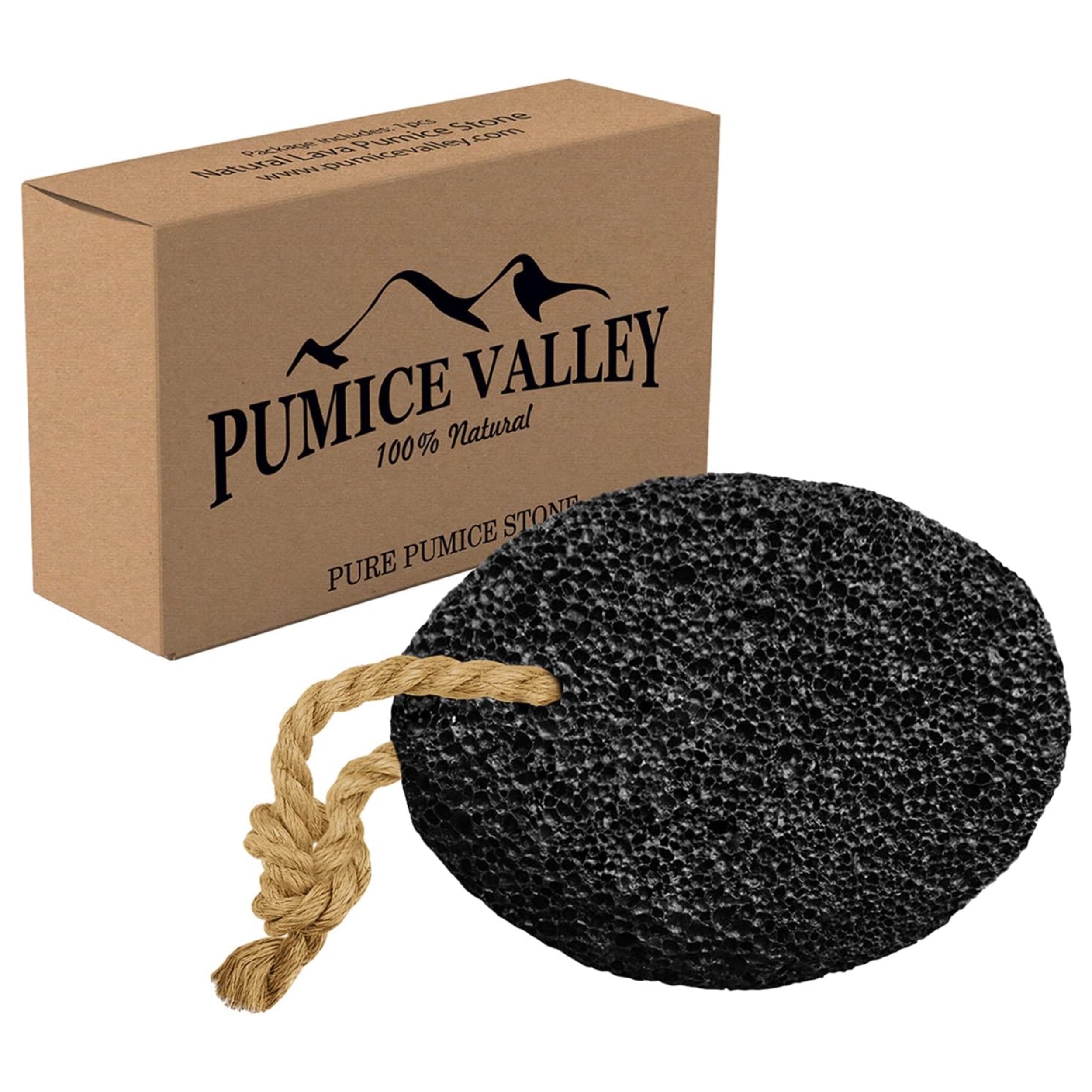
Pumice Valley uses natural volcanic pumice and believes shoppers deserve clear information about the stone’s origin and structure. Explore how our natural pumice stone is sourced and why each piece may have its own pore pattern, texture, and character.
FAQ
How can I tell if a pumice stone is real?^
Combine a clear natural-volcanic material disclosure with observations of structure, variation, density and water behavior. No one home test is definitive.
Does real pumice always float?^
No. Natural pumice can float or sink depending on bulk density and whether water enters connected pores.
Can a natural pumice stone be black?^
Color can vary with composition, weathering and lighting, so color alone cannot establish material origin.
Can I identify volcanic pumice from a photo?^
A photo can show useful pore patterns, but it cannot replace material and origin documentation.
Is water absorption proof that a stone is natural?^
No. Water behavior is one clue about pore access and is not exclusive to volcanic pumice.